
fibona Lab
fibona Lab is an "Experimental Playground":
Spatial Design for Co-Creating with Consumers
2026.09.09
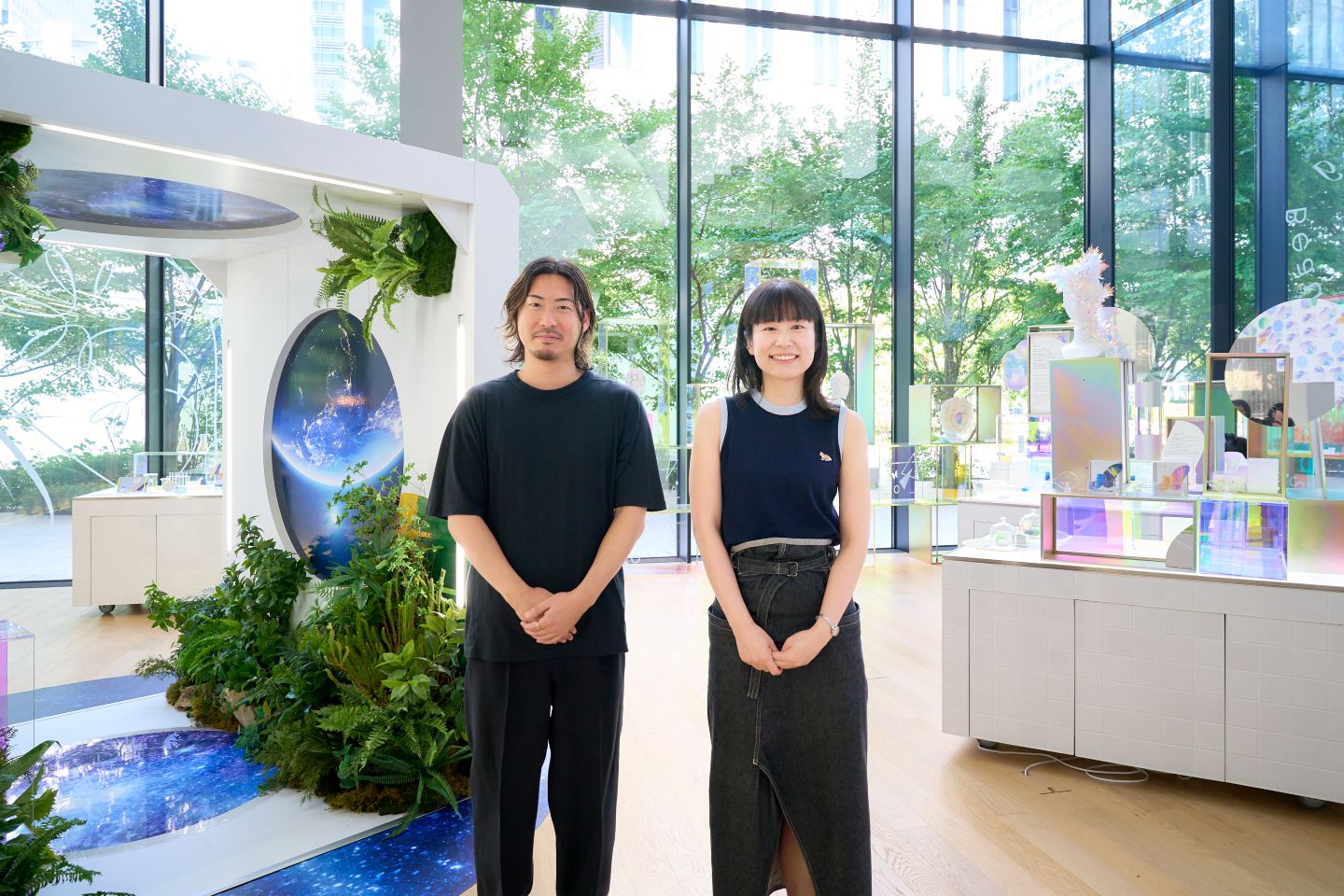
Co-creating beauty products that “don’t yet exist in the world”—this is the mission of Shiseido Research Center’s open innovation program, “fibona.”
Located on the 1st floor of the Shiseido Beauty Park in Minatomirai, Yokohama, fibona Lab refreshes its exhibits with every new product release, delivering fresh experiences to visitors.
What is this “experimental playground” where people can experience the products and philosophy of the fibona brand?
What kind of spatial design fosters true co-creation between researchers and consumers?
We spoke with fibona team member Akane Yanagihara and spatial designer Kei Ajima about designing exhibits unique to fibona Lab, as well as the nature of co-creation where researchers and consumers nurture products together.
fibona Lab: An “Experimental Playground” That Sparks Conversation
── First, could you tell us about your respective roles at fibona Lab?
Yanagihara: I handle prototyping and overall communication for fibona products, and I am also involved in spatial design from fibona’s perspective.
Ajima: I am responsible for the spatial design of fibona Lab within the Space & VMD Group of Shiseido’s Art & Creation Department.
── What do you value most in the spatial design of fibona Lab?
Yanagihara: What fibona values most is an attitude of ‘co-creation’—nurturing products together with consumers. It doesn’t end when a product is launched; we refine it based on customer feedback. That is the foundation of fibona as a ‘co-created product.’ The physical store is a venue for direct dialogue with customers. With the concept of an ‘experimental playground,’ fibona Lab designs the retail space from scratch for each product, creating a space where visitors can truly experience its world.
Ajima: To begin with, fibona products themselves are themed around challenging established conventions. Therefore, we want the retail space to be distinct from conventional cosmetics sales counters. I design with an emphasis on creating a place where visitors can not only look, but actually experience and play.
── Specifically, what kind of space is an “experimental playground”?
Yanagihara: fibona products incorporate various experimental elements. For example, while many products incorporate cutting-edge technologies from the lab, how can we translate that technology into valuable information and experiences for customers? Trying that out at the fibona Lab store is what makes it ‘experimental.’ At the same time, we cherish a sense of playful excitement. While typical stores focus primarily on the flow of understanding, gaining interest, and purchasing, fibona Lab prioritizes what happens beyond that: sparking conversations. Dialogue with staff and the voices shared on our comment boards are key examples.
── How do you proceed with the spatial design for each product?
Yanagihara: The first thing I share with Mr. Ajima isn’t detailed design specifications, but rather the product concept and hypotheses. We start with questions like, ‘Through this product, what hypothesis do we want to test?’ or ‘What kind of feedback do we hope to receive?’ We share what we want the space to evoke and what kind of customer voices we hope to inspire.
Ajima: There are traditional theories when it comes to designing cosmetics retail spaces, but through dialogue with the fibona development team, we can break free from those frameworks. That feels very fresh, and I’m given the freedom to take on new challenges. The key is to visualize the technology adopted in fibona products within the space and communicate it to customers. Even exceptional technology won’t lead to an experience if it isn’t effectively communicated. That’s why we dig deep into the background with the development team and hold numerous discussions on how to express it. This process is essential. I believe this is one of the places where Shiseido’s long-standing philosophy of ‘Art & Science’ is most prominently manifested.
Yanagihara: Designers, including Mr. Ajima, place great importance on designing from the ‘way of thinking.’ As researchers, we tend to be good at thinking about ‘specifics,’ which can sometimes make discussions complex. However, through dialogue with designers, we can return to our origins and build fibona’s value without straying off course.
Connecting Space and Earth: The Design Space for “Banbutsu Nanko”
── How did the current display space for “Banbutsu Nanko” come about?
Yanagihara: “Banbutsu Nanko” is a skin cream developed with specifications that allow it to be used inside the Japanese Experiment Module “Kibo” on the International Space Station (ISS). It was born from the idea of protecting skin even in harsh environments like outer space. Another key feature is its deeply moving scent, based on calming aromatic wood. It’s a skincare cream designed to accompany consumers in the various harsh conditions they experience in daily life.
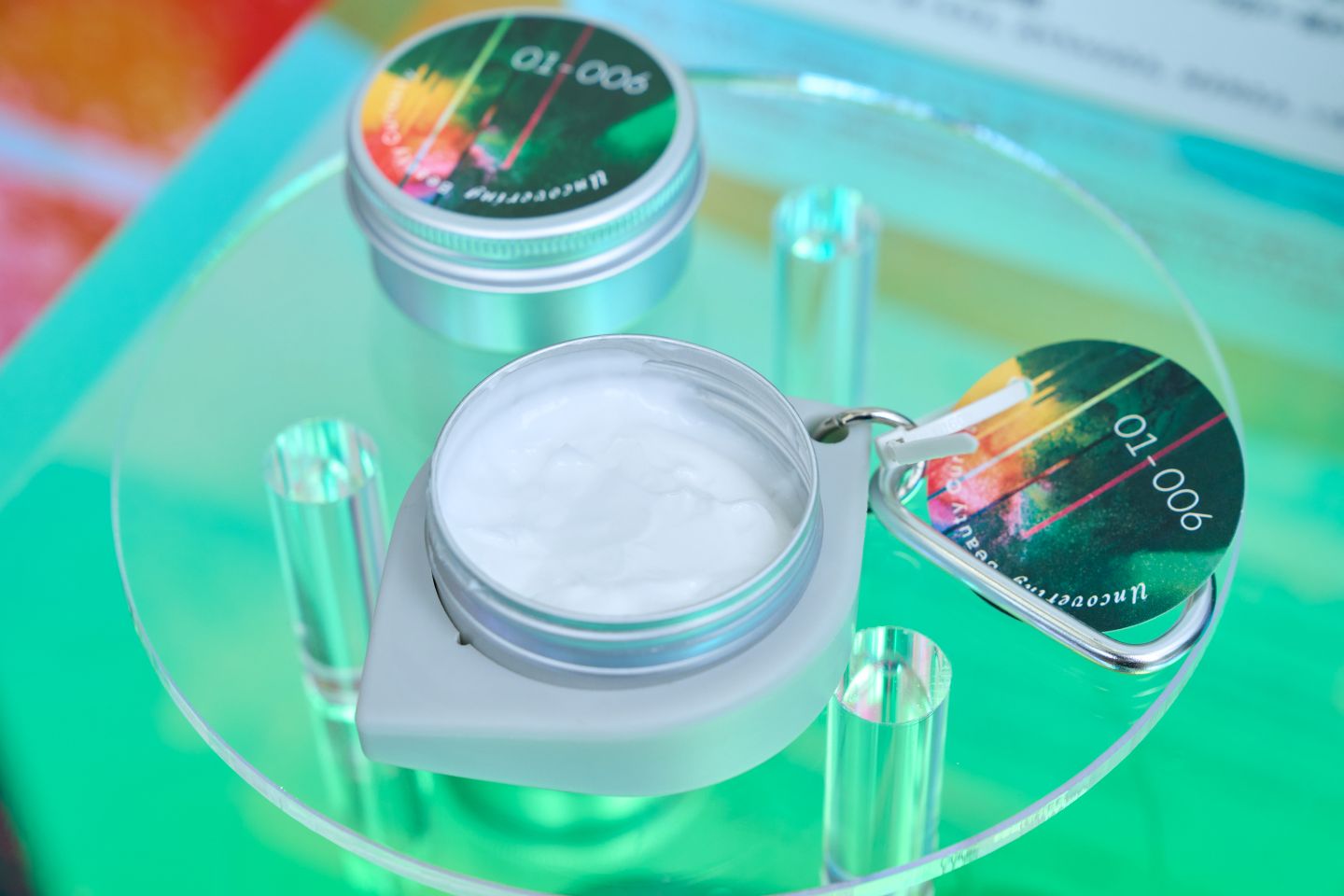
Ajima: In line with the product’s characteristics, we set the spatial theme as ‘an experience of sensing Earth’s fragrance from outer space.’ Learning that some astronauts feel homesick for Earth when spending long periods in space, we envisioned a slightly fantastical world where Earth’s nature bursts forth inside cosmic space. To realize this, we created a tunnel-like structure inspired by a space station, suspended the products in mid-air, and inverted the top and bottom of the space. When you take a photo through the circular window, the interior Earth and space appear upside down. It’s a mechanism allowing visitors to enjoy a subtle feeling of zero gravity in photos and videos. We also valued a sense of ‘intentional incongruity’—having living plants coexist within this cosmic environment.
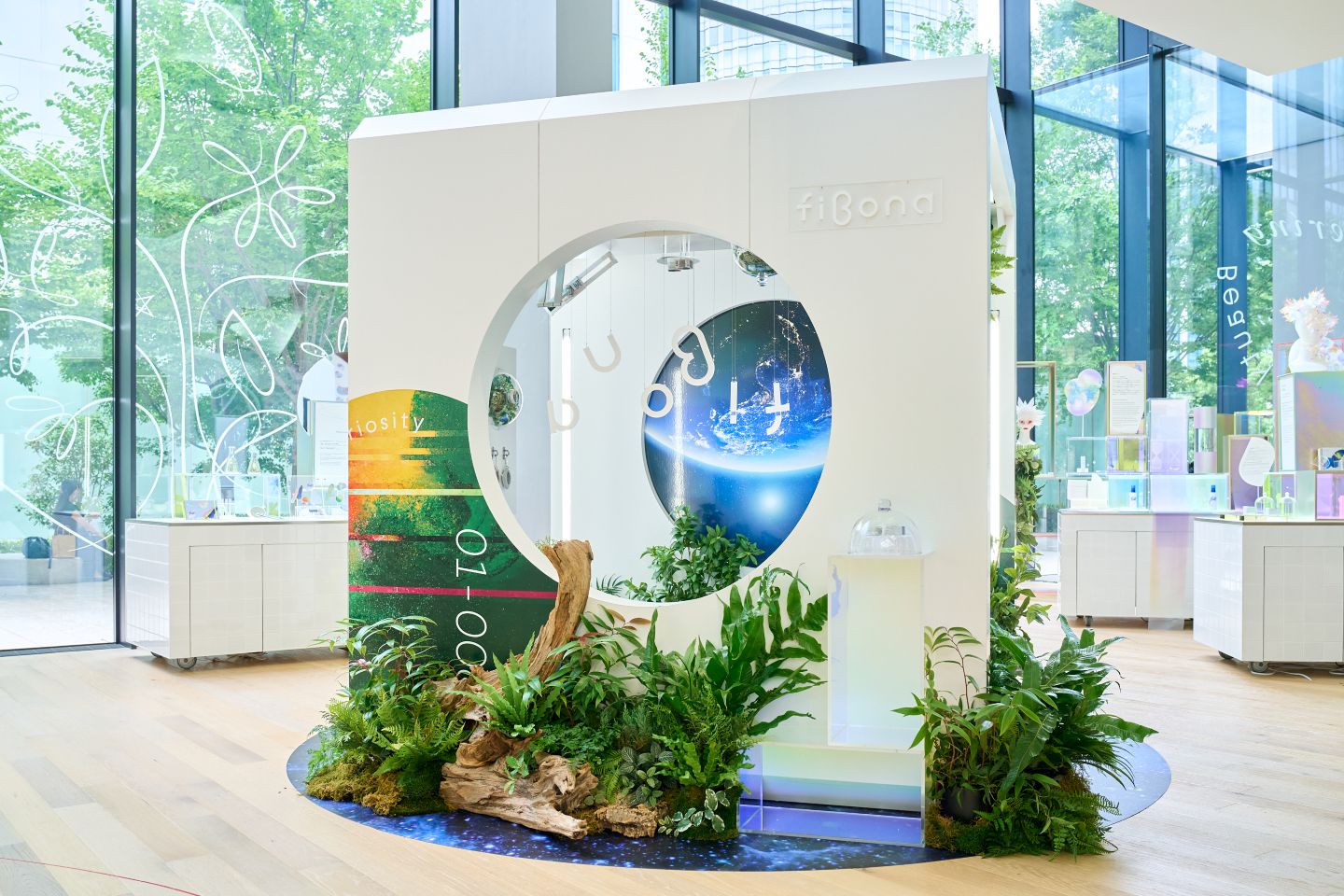
Yanagihara: “Banbutsu Nanko” itself is a lifestyle care item suitable for everyday environments on Earth. On the other hand, the background of it being engineered for space is a compelling story. Expressing that cosmic narrative at the storefront is a form of communication uniquely possible in a physical space.
── Were there specific points you kept in mind for visitors experiencing “Banbutsu Nanko” at fibona Lab?
Ajima: I thought it was essential for visitors to feel the ‘harsh environment’ setting when applying the cream. We wanted them to use the cream after getting a subtle feel for being in outer space, and experience whether there was any change in their sensory perception before and after.
Yanagihara: Customers who purchased it at fibona Lab have shared that they use it on their fingertips or inhale its scent when taking a moment to center themselves. Many seem to use it not just for moisturizing, but as a way to care for their emotional state. Perhaps the experience at fibona Lab, replicating a harsh environment, is reflected in how they use the product afterward.
── Exhibits showcasing co-creation with members of the online community “Club fibona,” as well as videos sharing development stories with researchers’ voices, are also on display, right?
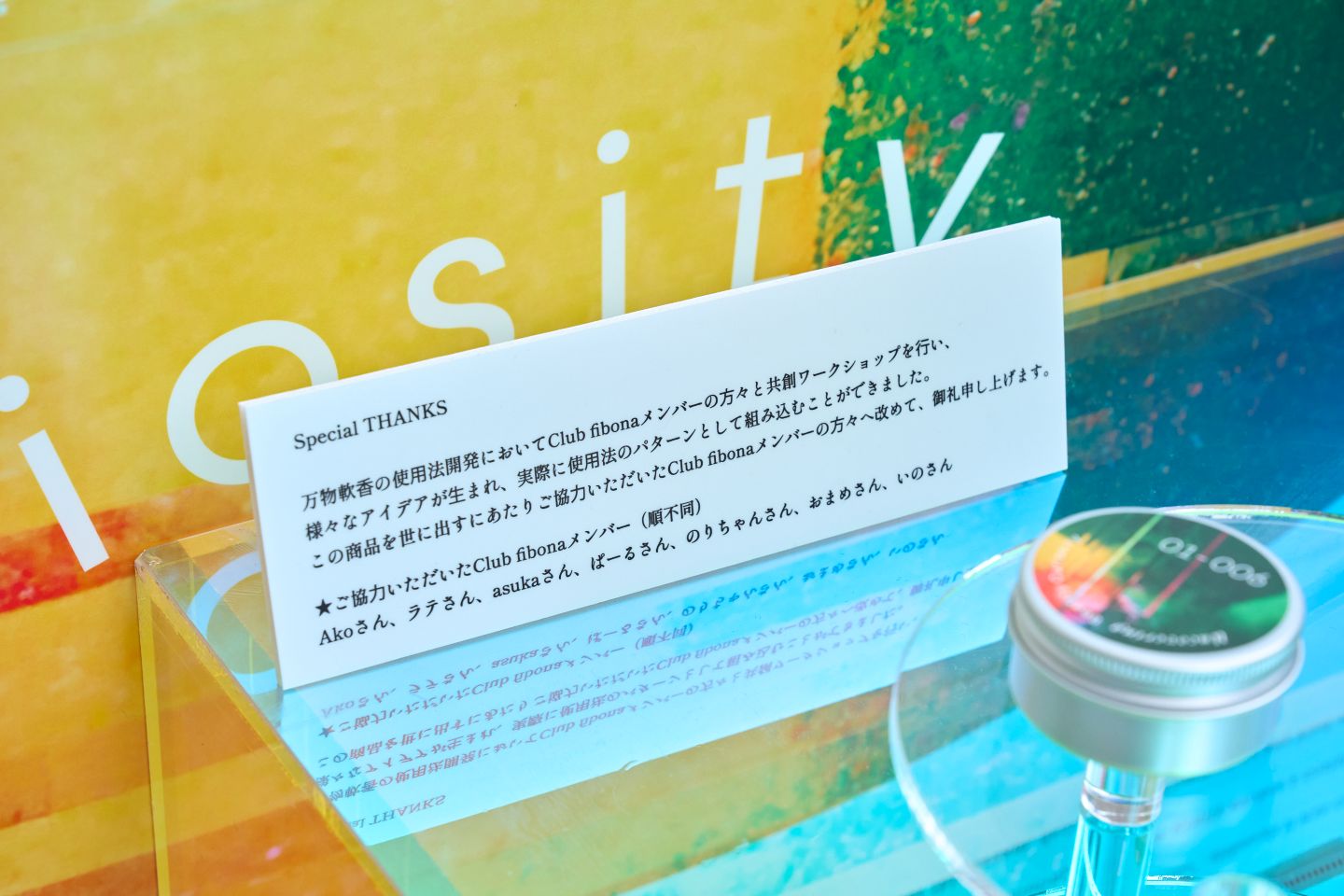
Yanagihara: With Banbutsu Nanko, we tried something new during the development phase: brainstorming product usage and scenarios together with Club fibona members. When participants of the co-creation workshop visit the store, we want them to feel ‘I’m glad I participated.’ I consulted Mr. Ajima on how to convey that collaborative process within the space.
Ajima: Hearing that, I wanted to bring these co-creative efforts front and center. For visitors who haven’t participated, watching the video serves as an opportunity to discover Club fibona and realize that products are being created alongside consumers. Regarding the videos introducing the researchers, I wanted to convey not just the finished product, but also the people behind it. By showing the faces of the researchers, I hoped to make the space one where visitors can feel the background of how products come to life.
Product Worldviews Experienced Through Space
── Could you also look back on the spatial designs for the fibona brand products released since 2025?
Ajima: For the spatial design of ‘Skin Accessory’—the first release from the fibona brand—we combined oxidized chrome plating with acrylic boxes, adopting a modular format that could be freely reconfigured. When natural light from outside hits the acrylic, it creates prisms. It’s a design that expresses the organic and the inorganic through light and contrasting materials. Furthermore, we designed the layout so that the experience deepens the more visitors walk around—moving from a casual trial area to a space where they apply it to their skin. It’s set up so that as you walk through, you encounter different views and experiences of the product. Additionally, in collaboration with an in-house makeup artist, we exhibited artwork applying second-skin technology. ‘Infinite transformation’ and ‘variability’ were the overarching themes of the space.
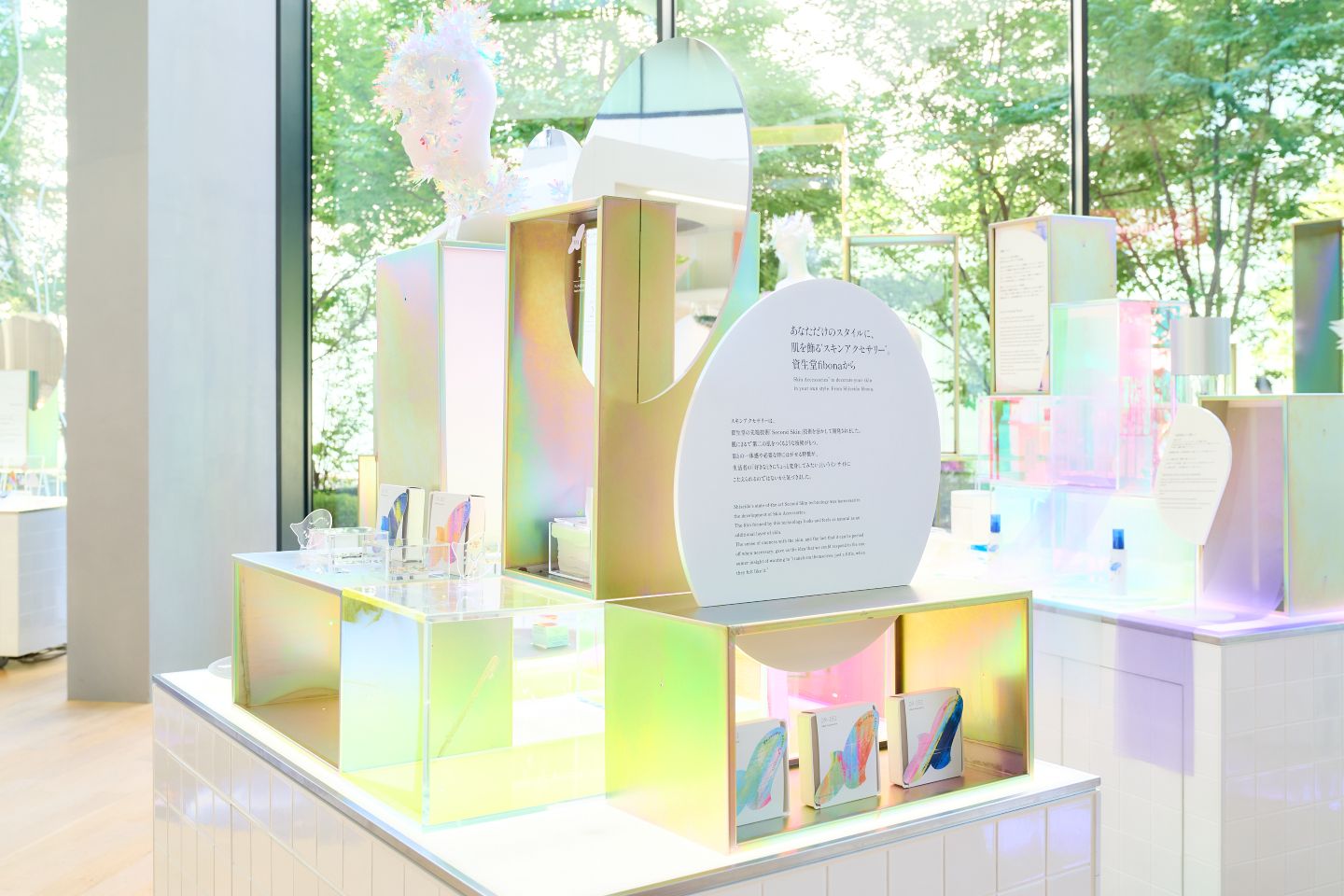
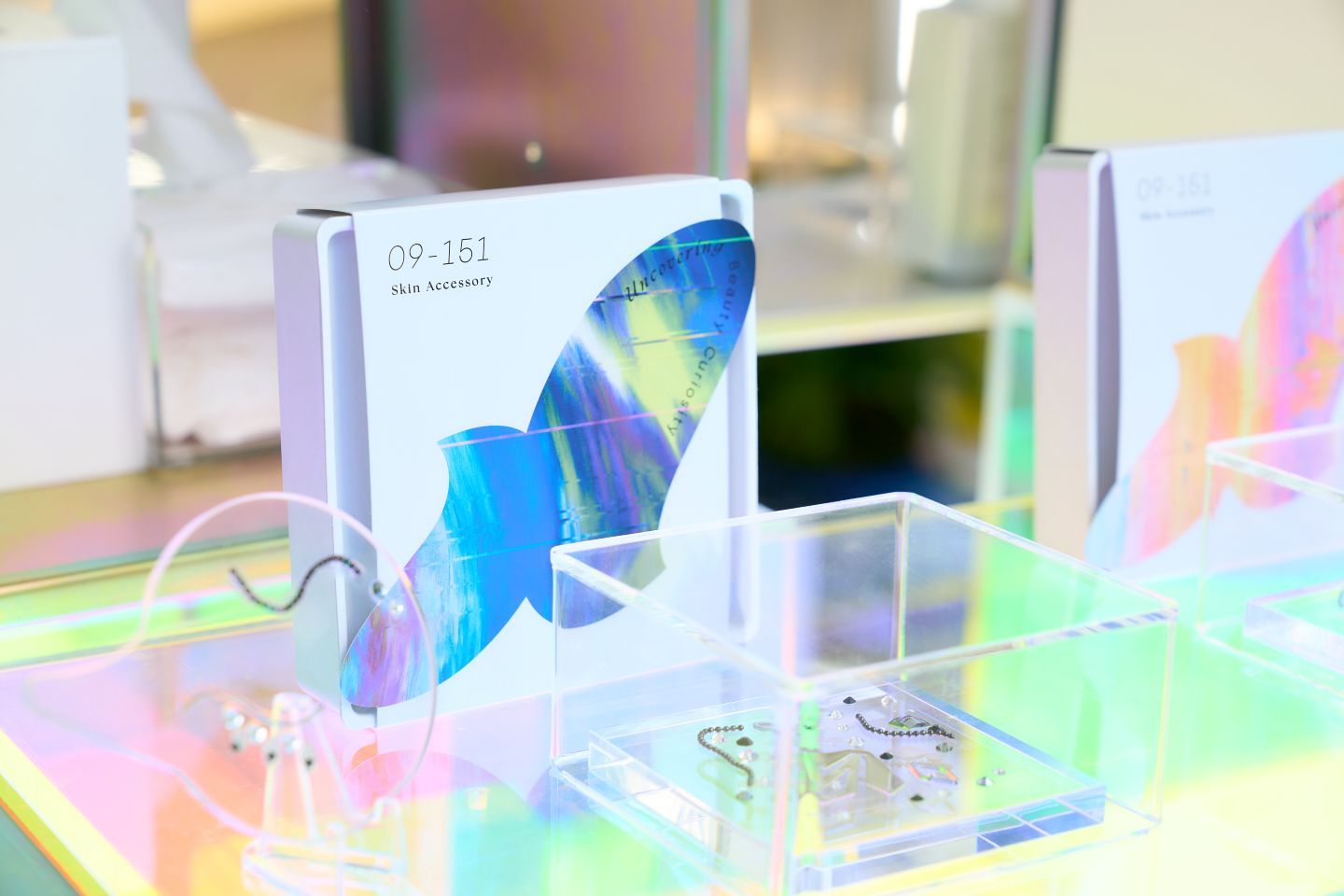
Yanagihara: At that time, we were in the process of shaping the brand concept of fibona itself. Looking at the completed space, I vividly remember feeling strongly reconnected to the idea that continuously transforming and going beyond established concepts is the very identity of fibona.
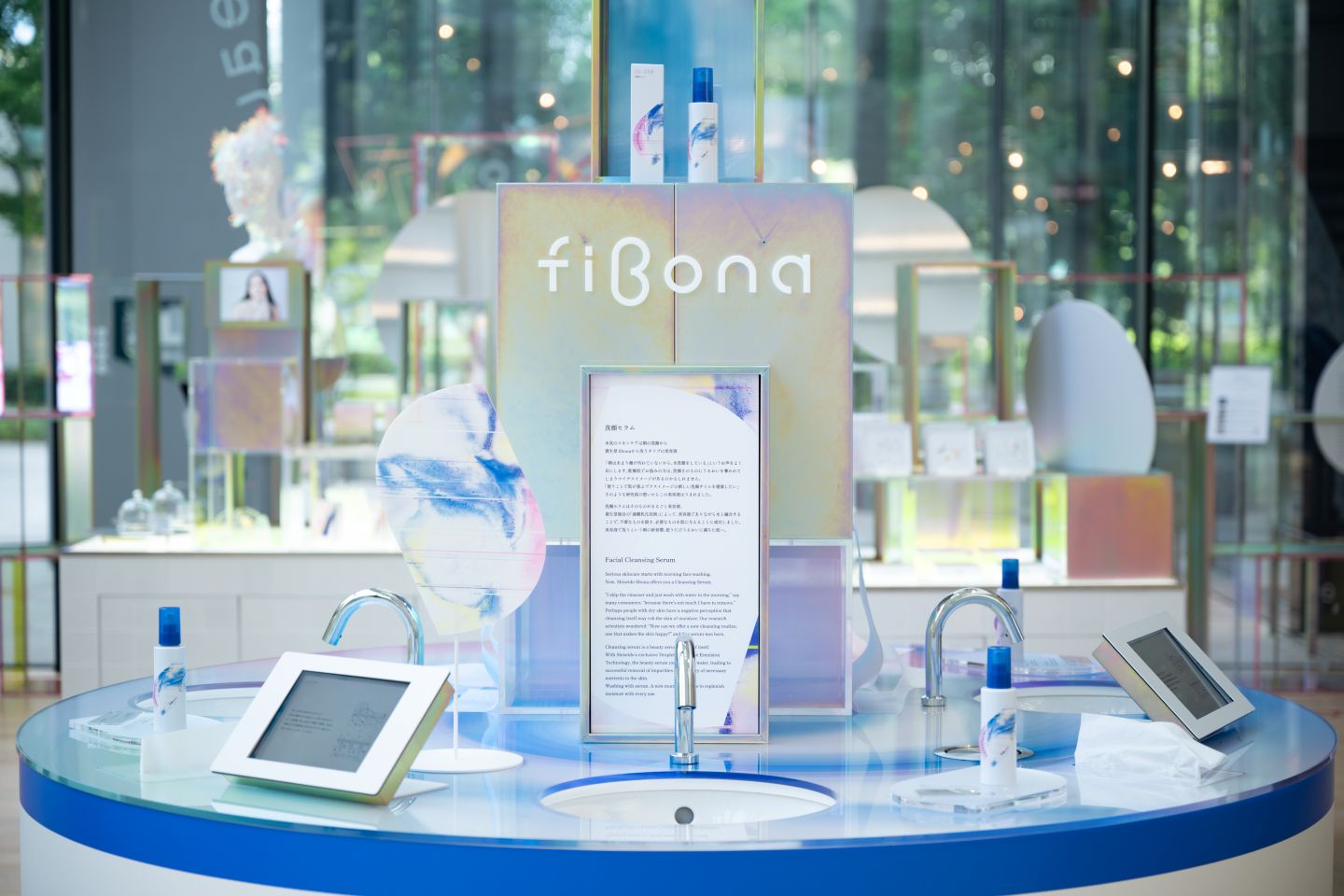
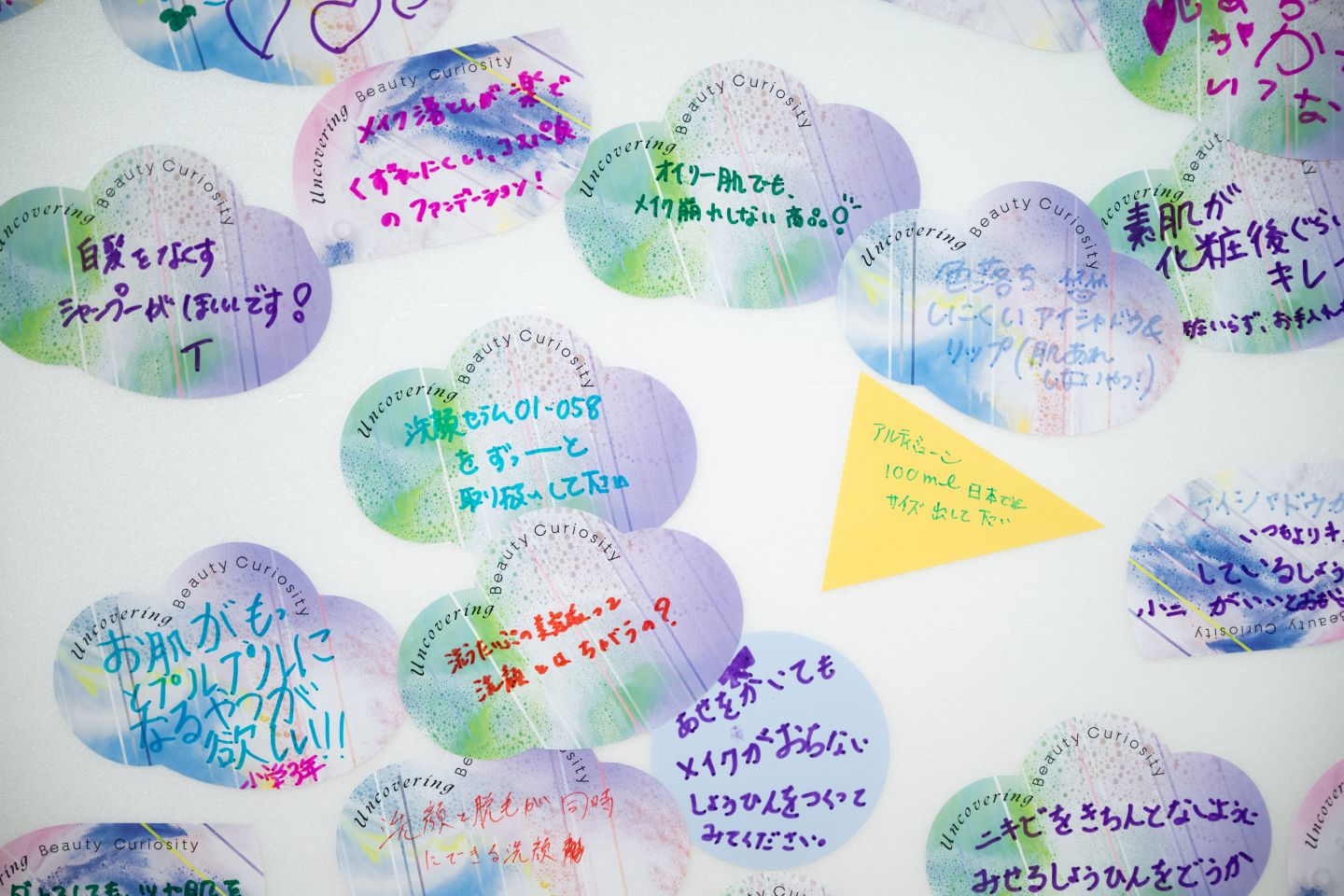
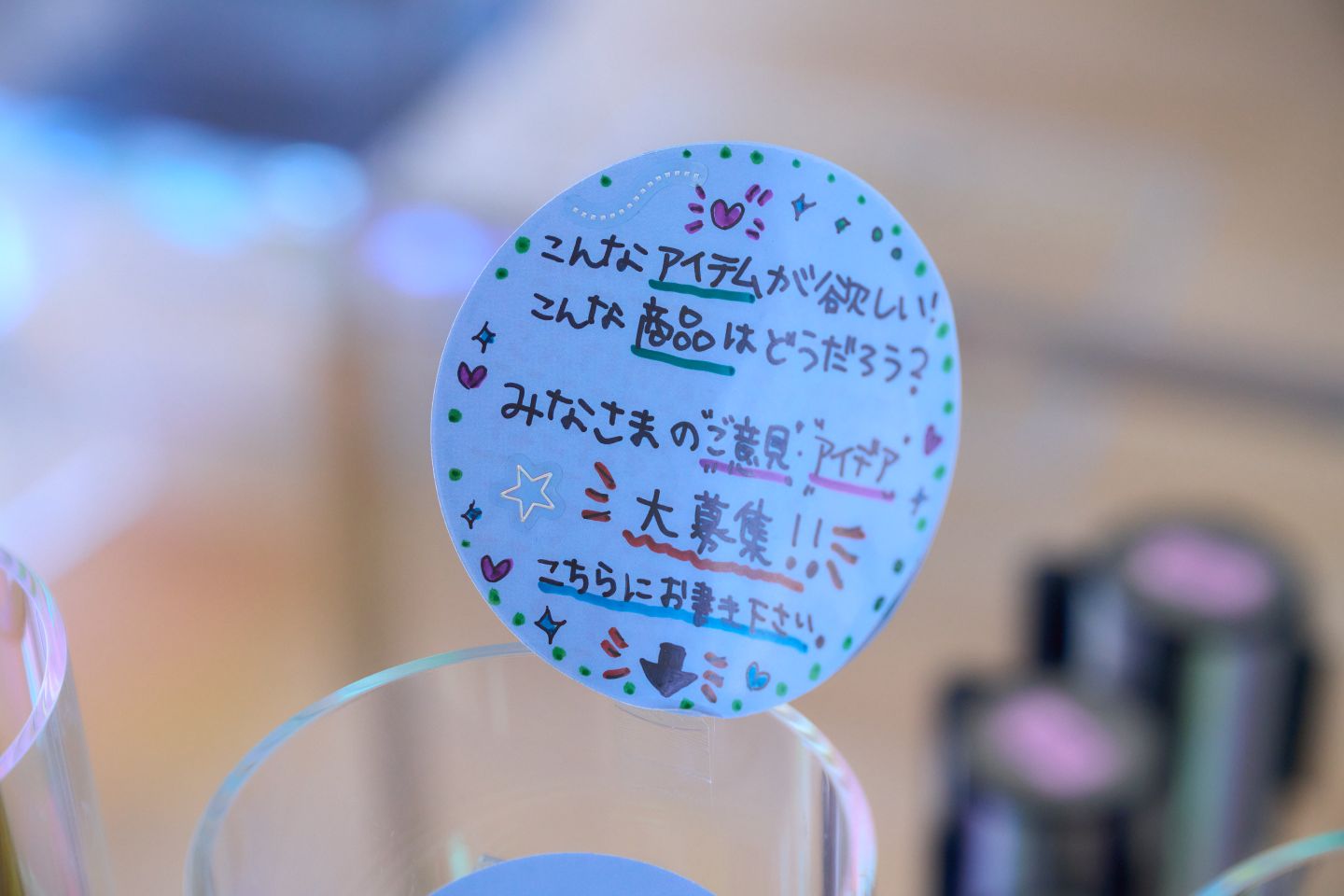
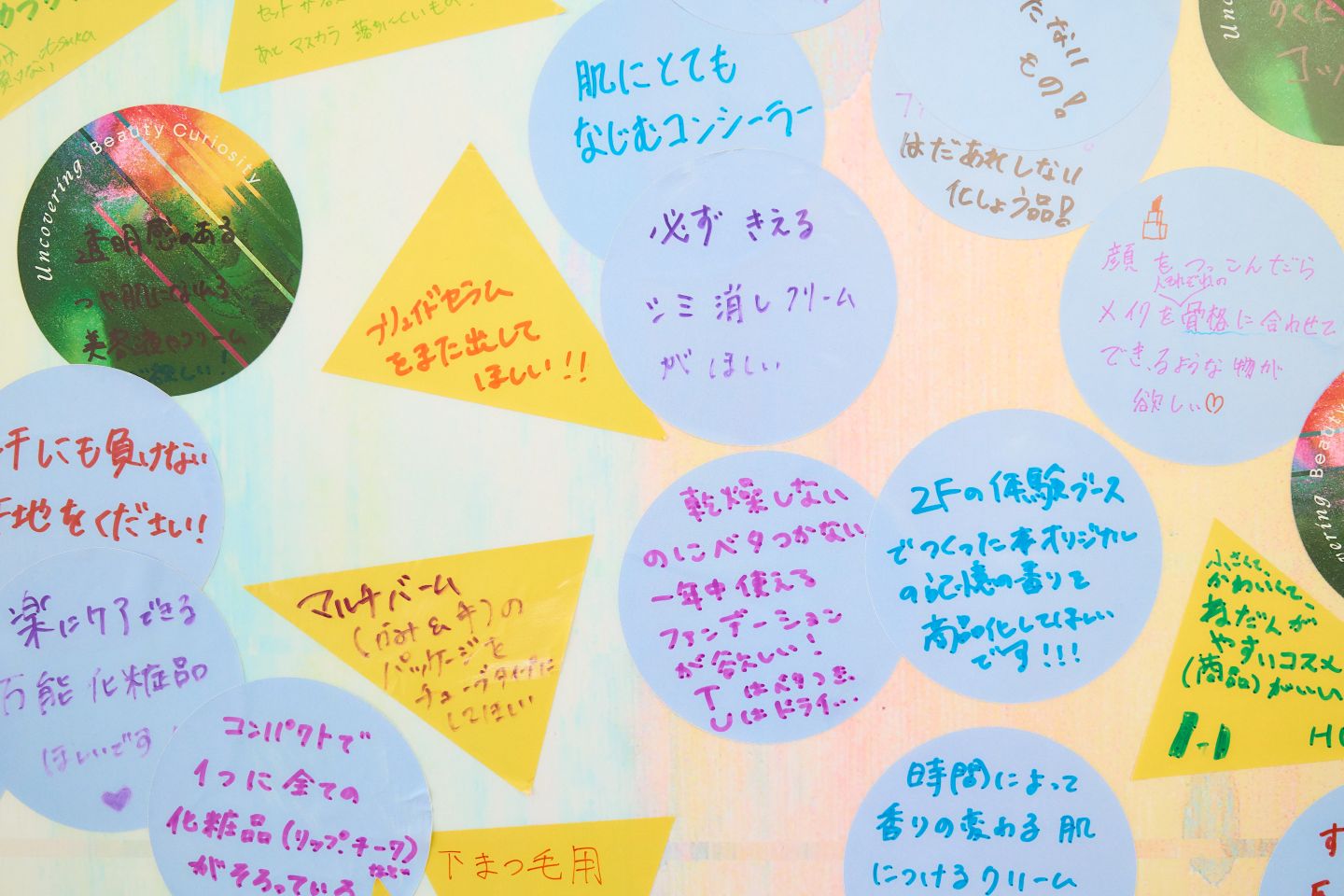
Ajima: For the second release, ‘Facial Cleansing Serum,’ inspired by the concept of ‘cleansing with a serum,’ we chose ‘purification’ as the keyword. Based on the colors of the product label, we hung fabrics printed with gradients, creating a space evocative of being underwater or near a waterfall. Aiming for an experience where visitors could refresh their minds while trying the product, we installed a washing station for actual use. From this point onward, we began displaying large pop-up signs featuring questions from researchers, such as ‘What kind of item do you want?’ right Right at the store. Visitors write their answers or product impressions on sticker cards and post them on comment boards. Incorporating this mechanism directly connected researchers’ questions with customer voices through the fibona Lab space.
── The third release, “Fluid Serum #1,” was a space where visitors could experience research technology firsthand, wasn’t it?
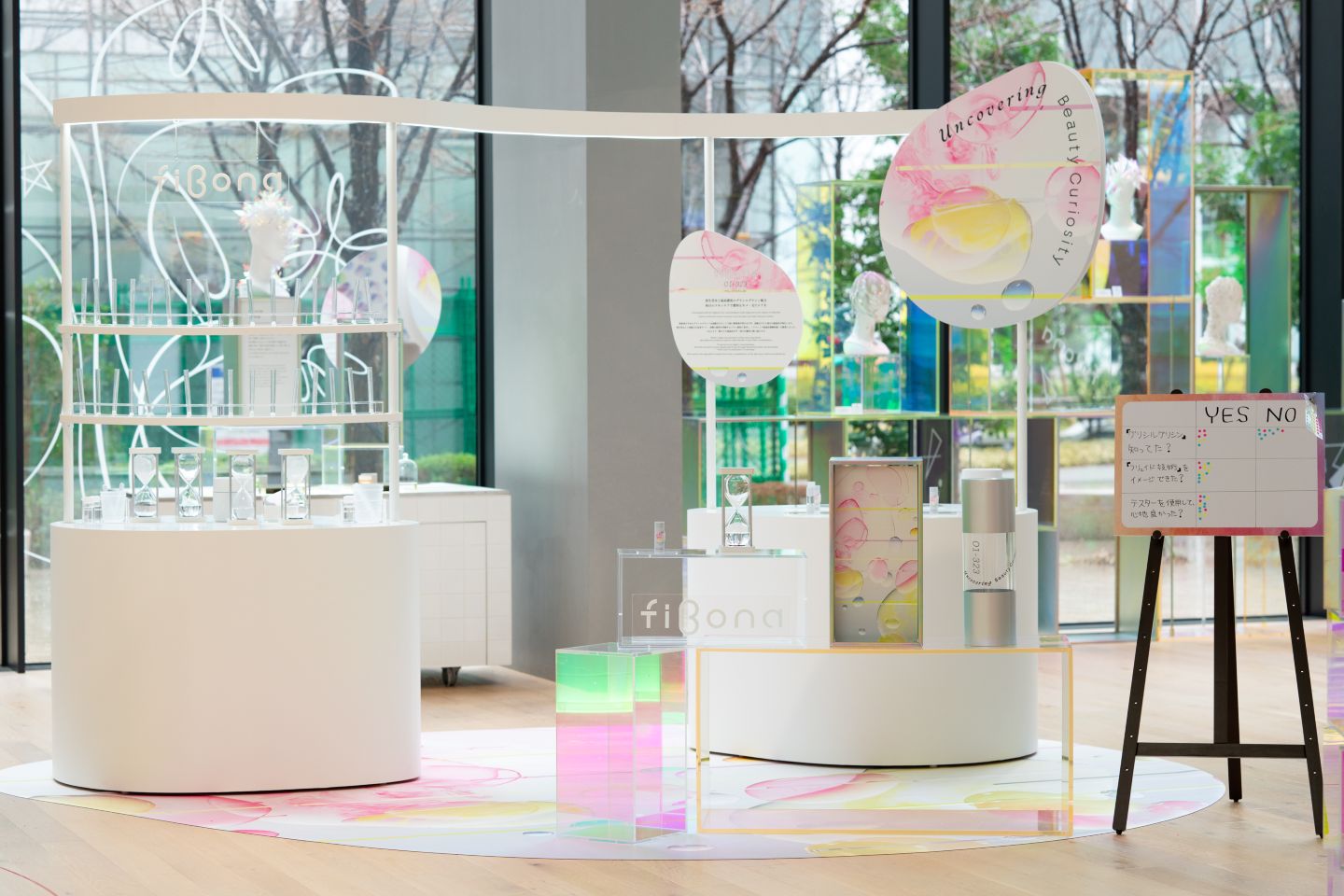
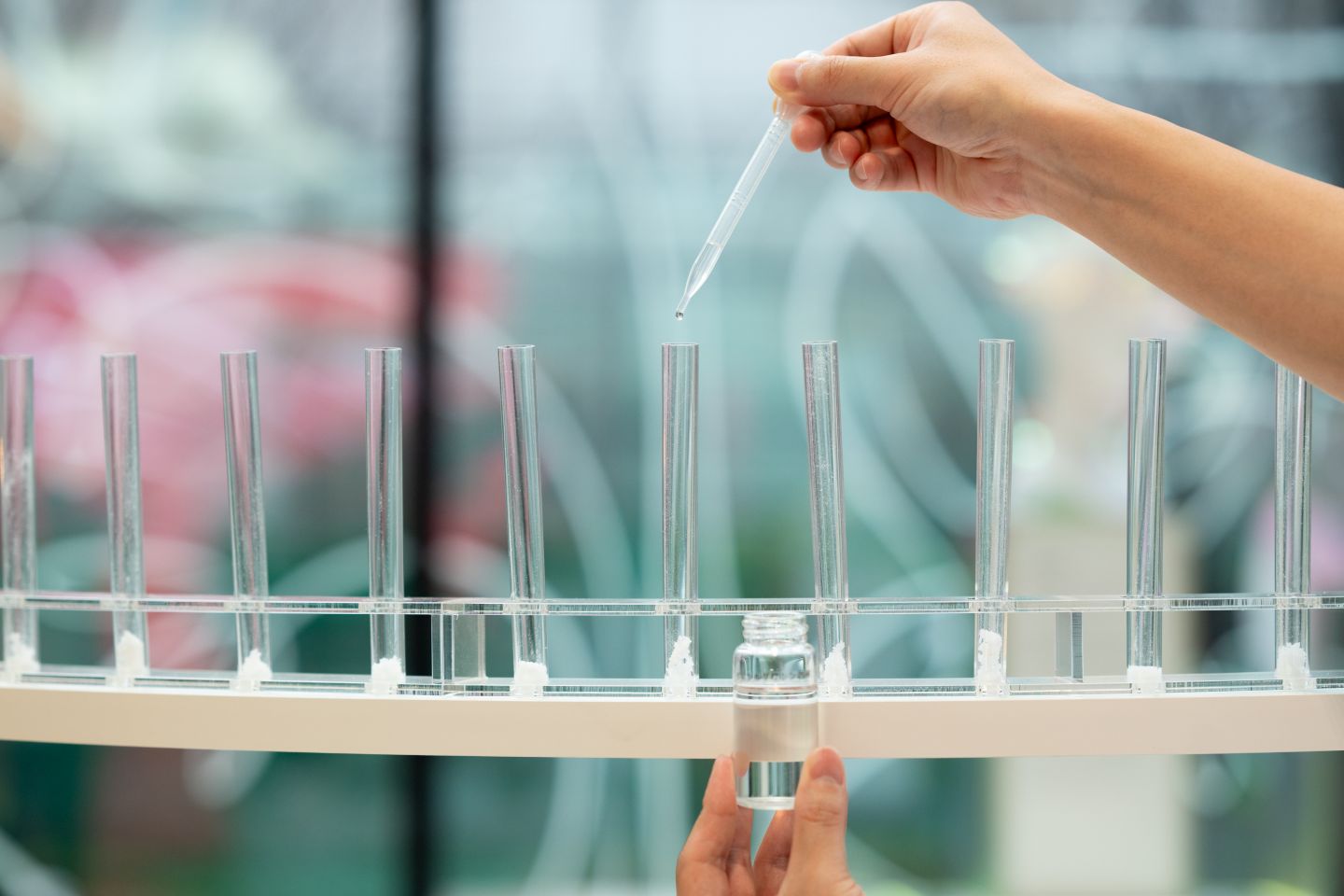
Ajima: With ‘Fluid Serum #1,’ we wanted visitors to experience just how remarkable a high-concentration formulation of glycylglycine is. So we designed fibona Lab to look literally like a science lab, creating a space where staff and customers could experience liquid crystallization together. In addition, we prepared hour-glasses containing liquid and crystallized glycylglycine respectively. When flipped, the crystals get clogged without falling, while the liquid passes right through. This visually expressed the core ‘Fluidized Crystal Suppression Technology.’ I believe the spatial design for ‘Fluid Serum #1’ became a concrete form of ‘tech entertainment’—where technology isn’t just explained verbally, but felt through personal experience.
Yanagihara: Specialized technologies can be hard to convey through written or verbal explanations alone. But seeing it with an hour-glass makes it intuitively clear. I realized the power of visual communication in a space and the importance of tangible experience.
A “Virtuous Cycle of Co-Creation” Built with Customer Feedback
── So fibona Lab itself is a place born out of “co-creation” between researchers and customers.
Ajima: fibona Lab isn’t a place for one-way information consumption. It’s a place where you can enjoy learning about products and build them together. I think the beauty of this space lies in fostering that kind of two-way communication.
Yanagihara: In a year and a half, we’ve already collected over 1,000 comments from customers. It’s an immense asset for fibona, the researchers, and the entire research center. Our online community, ‘Club fibona,’ has reached over 400 members, and I feel the framework for receiving ideas and feedback is firmly in place. Currently, we are tackling the challenge of digitizing these collected voices and figuring out how to feed them back into the next experiences and products. True co-creation means not stopping at receiving feedback, but making customers feel that ‘my voice made a difference.’ If opinions are reflected in products and experiences, people will want to give feedback again. We want to build that ‘virtuous cycle of co-creation.’
── Finally, please tell us what you’d like to challenge yourselves with in the spatial design of fibona Lab moving forward.
Ajima: fibona Lab is more than just a retail space; it attracts a remarkably diverse demographic. Beyond Shiseido fans, we see families, local university students, people visiting nearby concert venues, and passersby who drop in without prior knowledge of Shiseido. Meeting people outside our usual cosmetics customer base and receiving their voices is refreshing for me too. Involving such diverse people, I hope to take on new co-creative challenges and build spaces that reach an even broader audience.
Text: Ikumi Tsubone Photo: Umihiko Eto, Yuko Kawashima Edit: Kaori Sasagawa