
fibona Lab
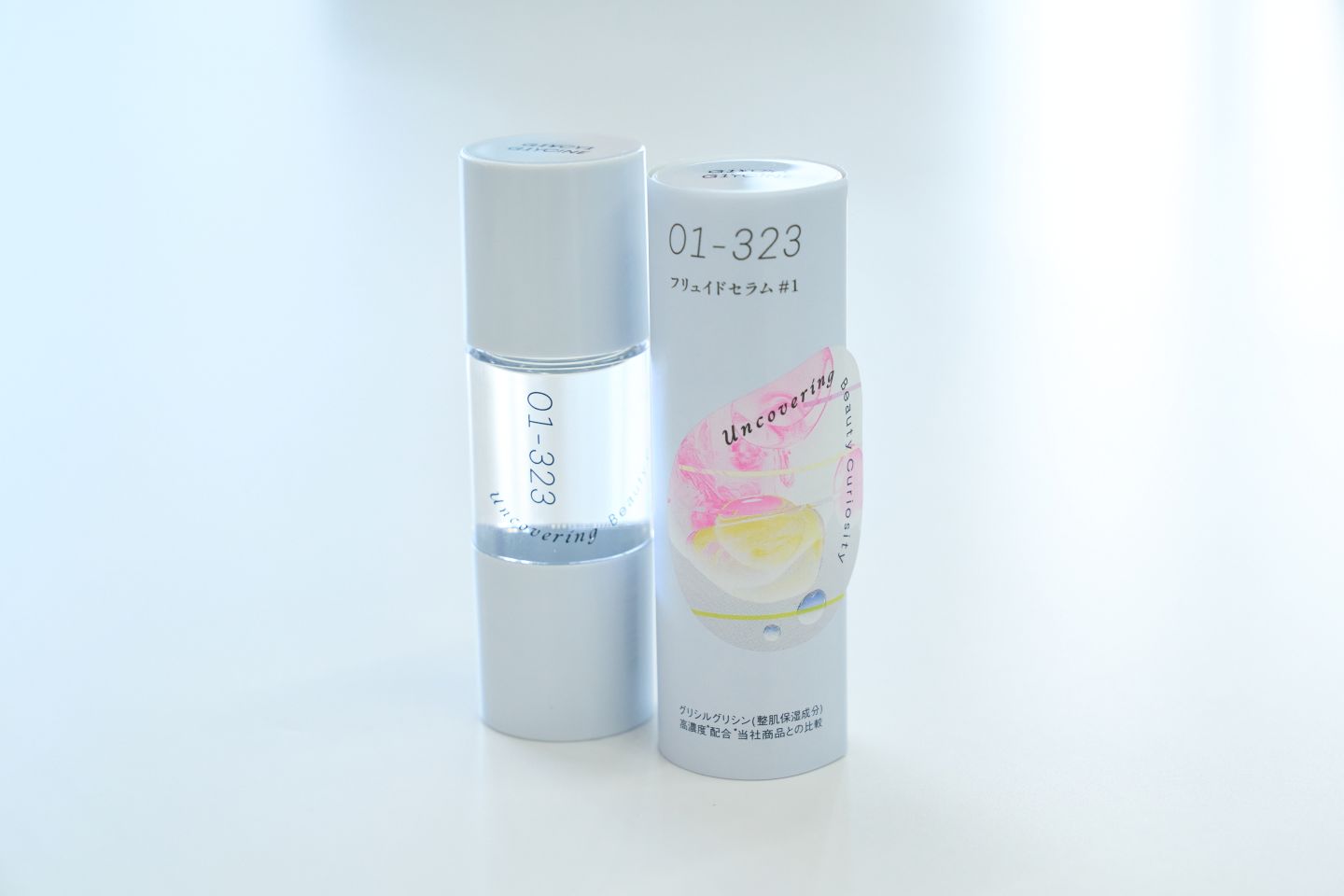
Formulated with the highest concentration*¹ of glycylglycine in Shiseido’s history,
“Fluid Serum #1” for refined texture and pore care.
A minimalist development challenge taken on by fibona researchers.
2026.03.13
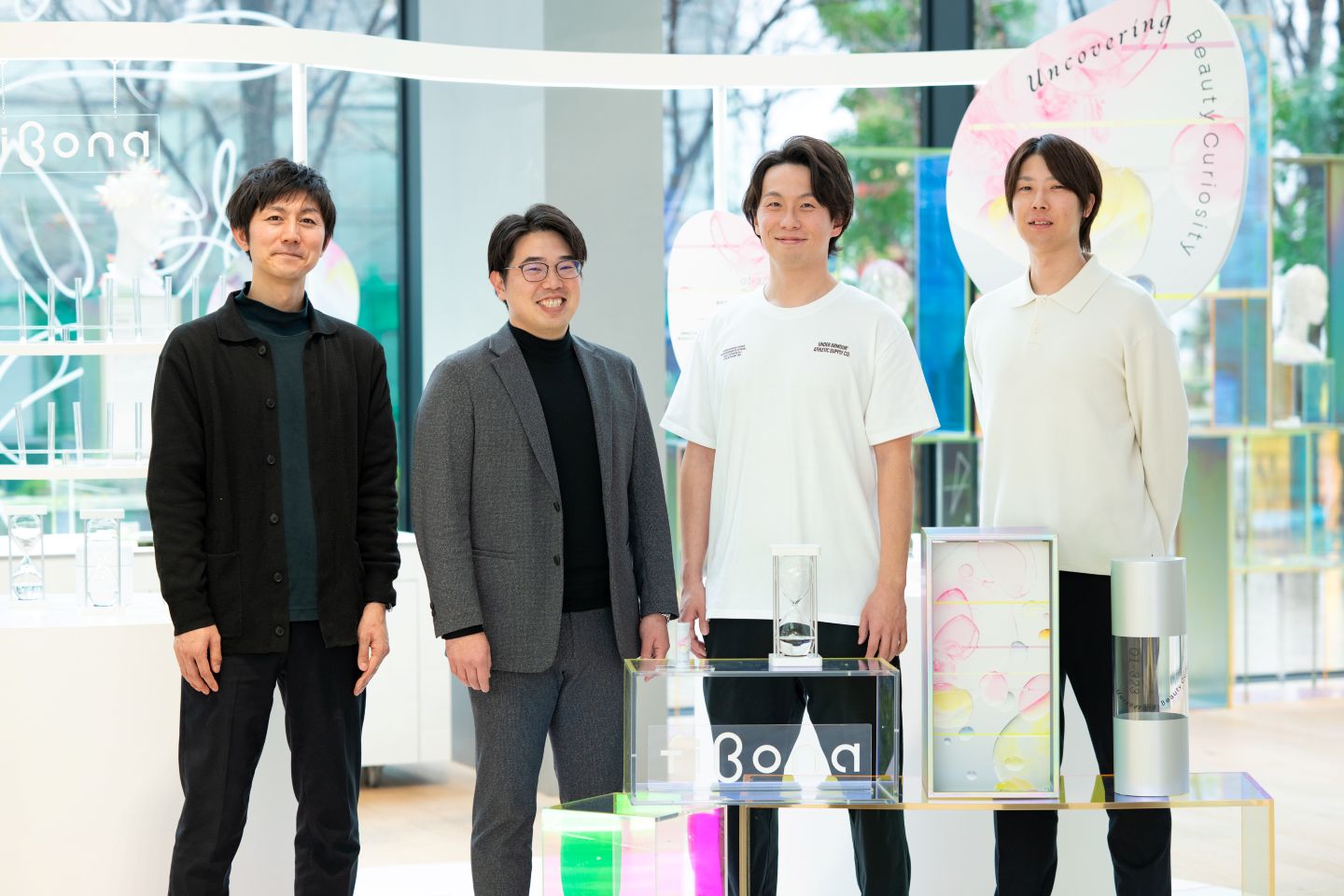
Shiseido Research Institute’s open innovation program, “fibona,” is dedicated to co-creating beauty products that bring “what does not yet exist” into the world. In January 2026, fibona launched “Fluid Serum #1,” a serum designed to address pore concerns. The product quickly drew significant attention, with lines forming on the first day of sales at the fibona Lab on the first floor of Shiseido Beauty Park (SBP).
The key concept underlying the product is “minimalism.” From Shiseido’s proprietary technologies and formulation to its packaging, “Fluid Serum #1” is a creation made possible precisely because it was developed by researchers. We spoke with the development team to learn more about the story behind the product.
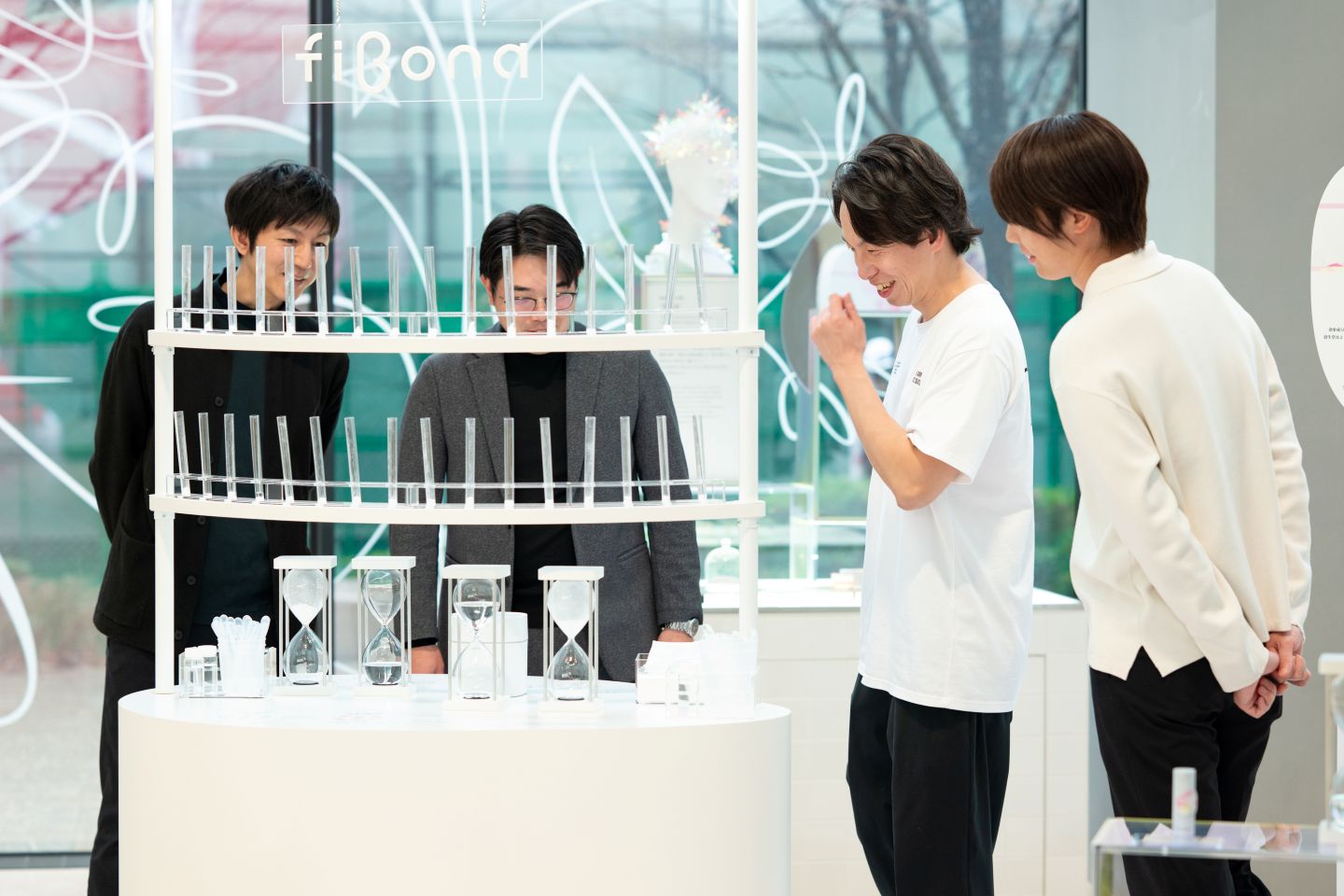
The “Fluid Serum” Development Team
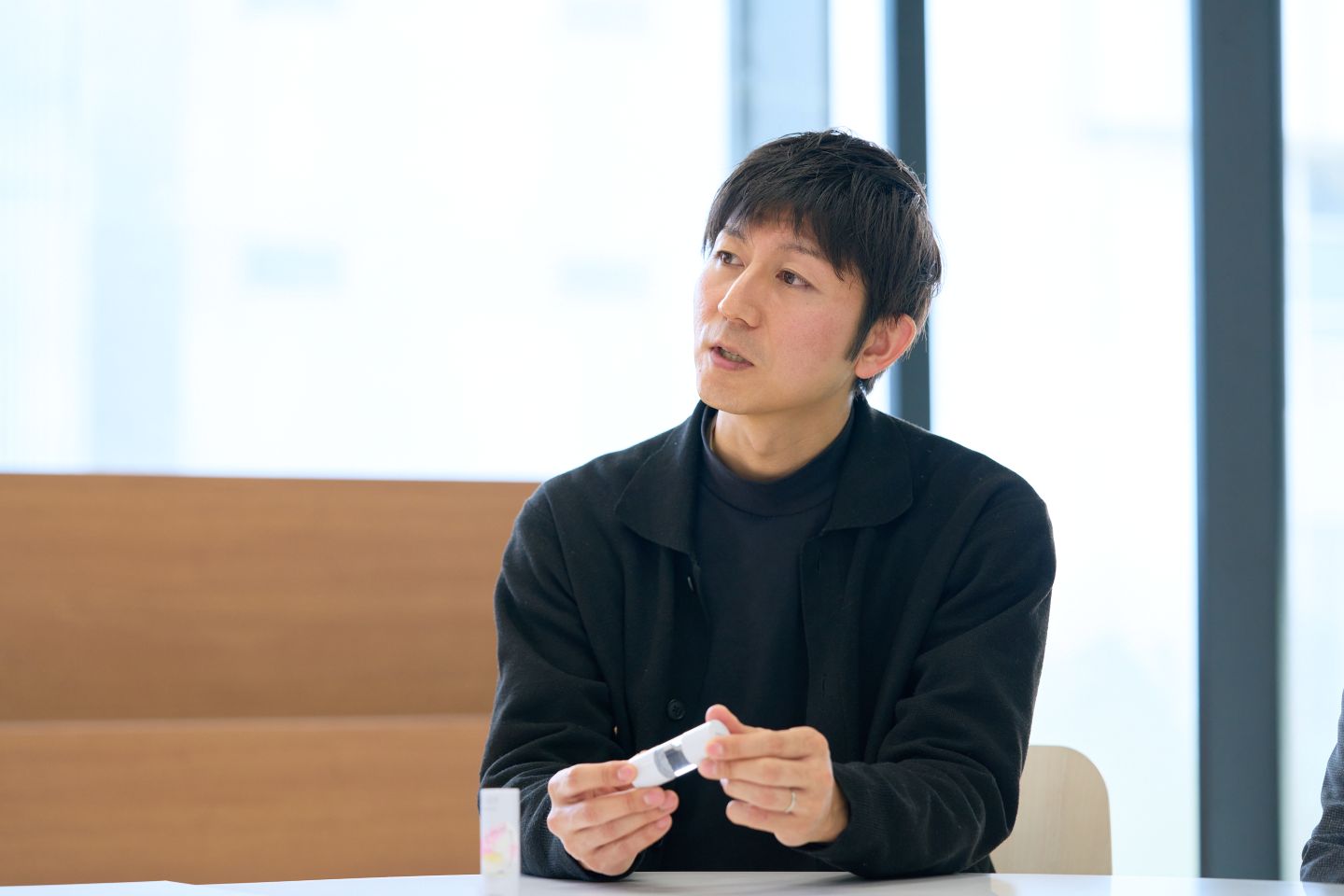
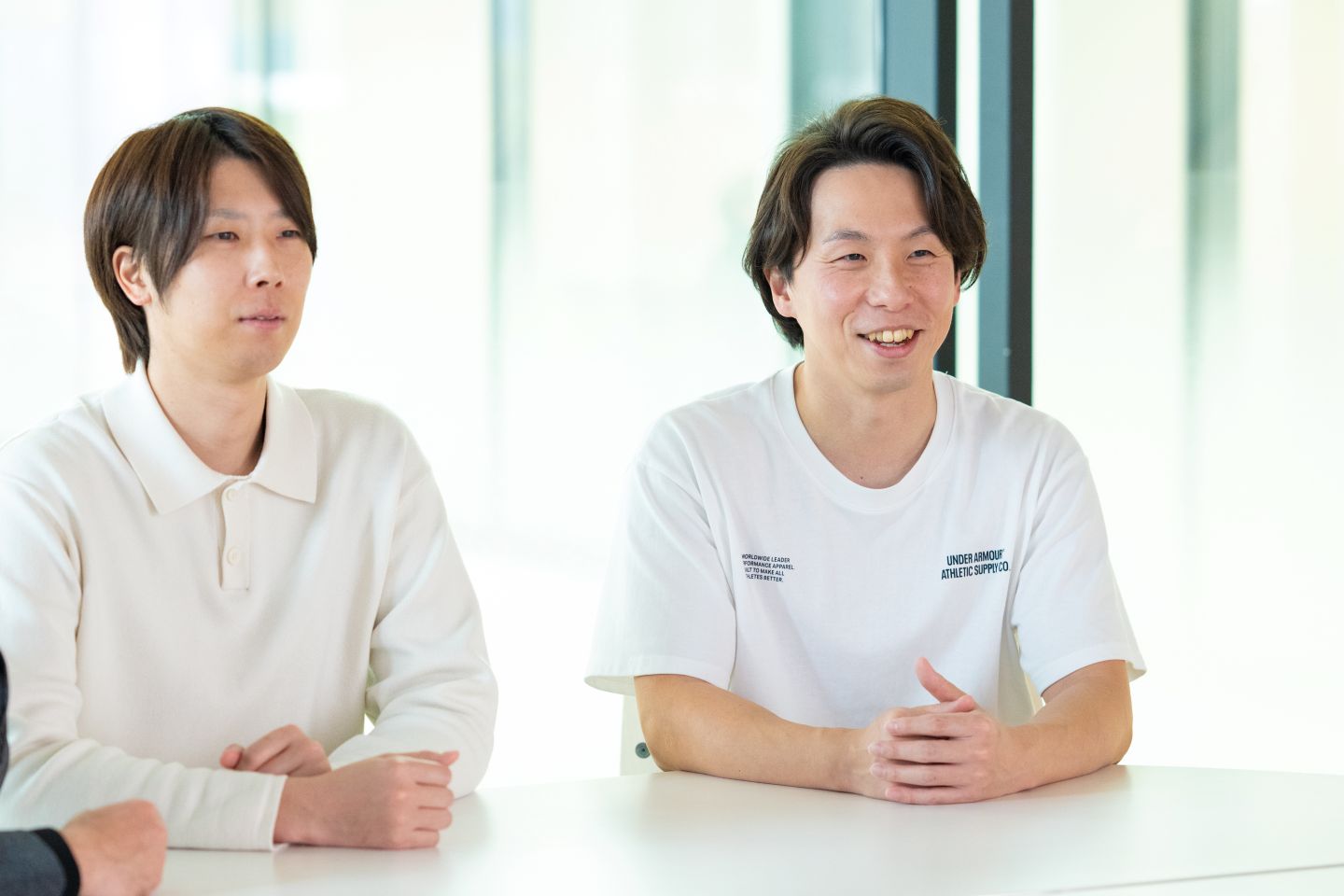
(From left in the photo) Kosuke Otaka, Kento Ueno, Seiji Nishikawa, Mitsuki Nakamura
*1 Compared to our existing products
Creating a Product That Embodies “Minimalism”
— To begin, could you tell us about your respective roles in the development of “Fluid Serum #1”?
Ueno:
As the project initiator, I was responsible for shaping the product concept and defining the benefits we wanted to deliver to our customers, always keeping an eye on the bigger picture. In my regular role, I work on communication development and brand management for Shiseido. This time, however, rather than acting as a “leader,” I approached the project more like a producer, bringing together the unique expertise of each development team member.
Experts from different fields combined their strengths and worked as one team. If I had to put it simply, we were like the “Avengers” (laughs).

Nishikawa:
I worked alongside Ueno on the project planning, focusing primarily on the formulation strategy—specifically, how to incorporate ingredients into the cosmetic base and how to deliver them effectively to our customers.
In addition, at the fibona Lab on the first floor of SBP, I was responsible for designing how we communicate with customers and create meaningful experiences for them. This included planning and designing the booth to ensure the product’s value could be fully experienced.
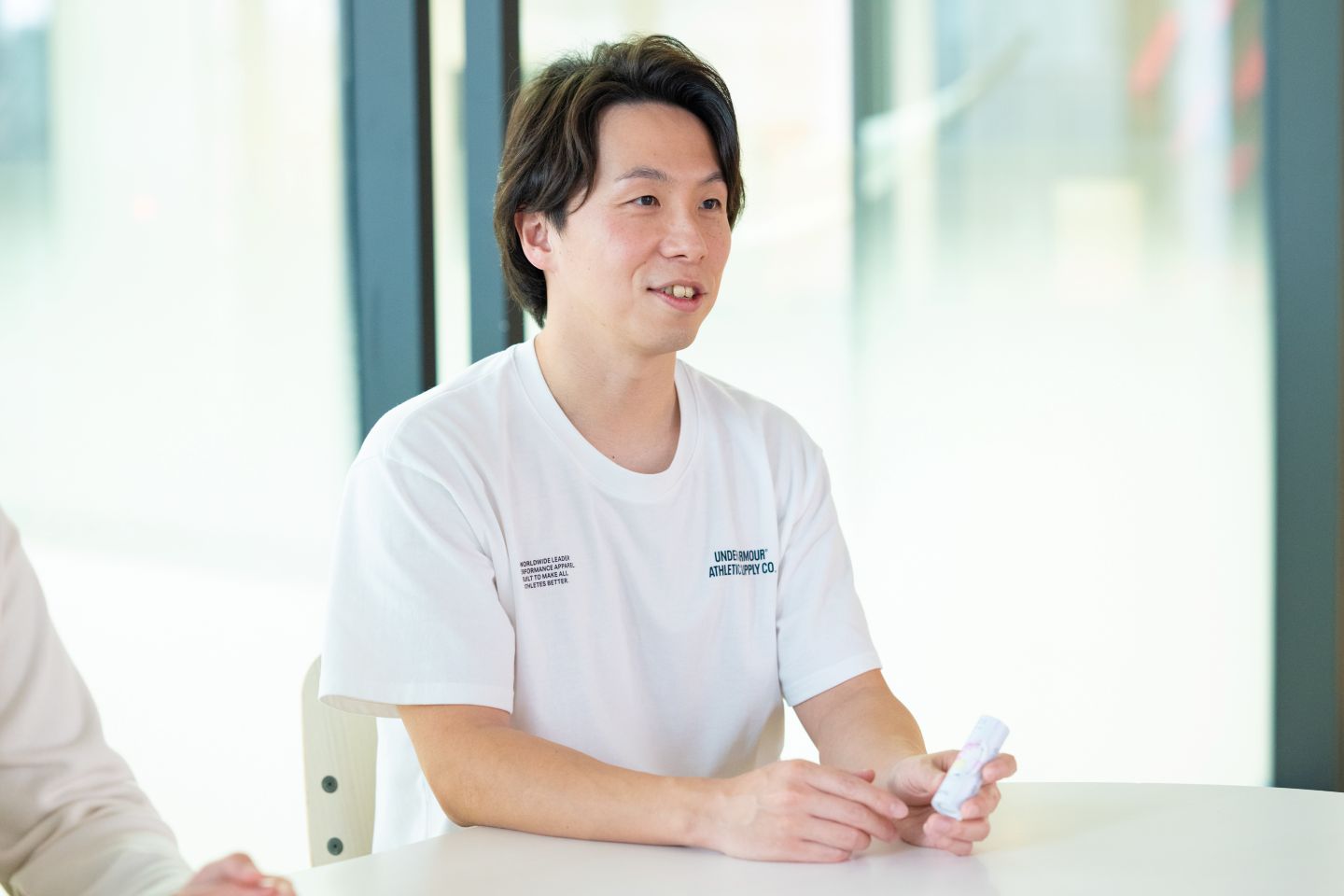
Nakamura:
I was responsible for developing the cosmetic base formula. I usually conduct research on skincare formulation technologies, but for this project, I was involved from the very first step—selecting the ingredients—through to defining the final skin benefits we wanted to deliver. Through ongoing discussions with the team, we built the formula together from the ground up.
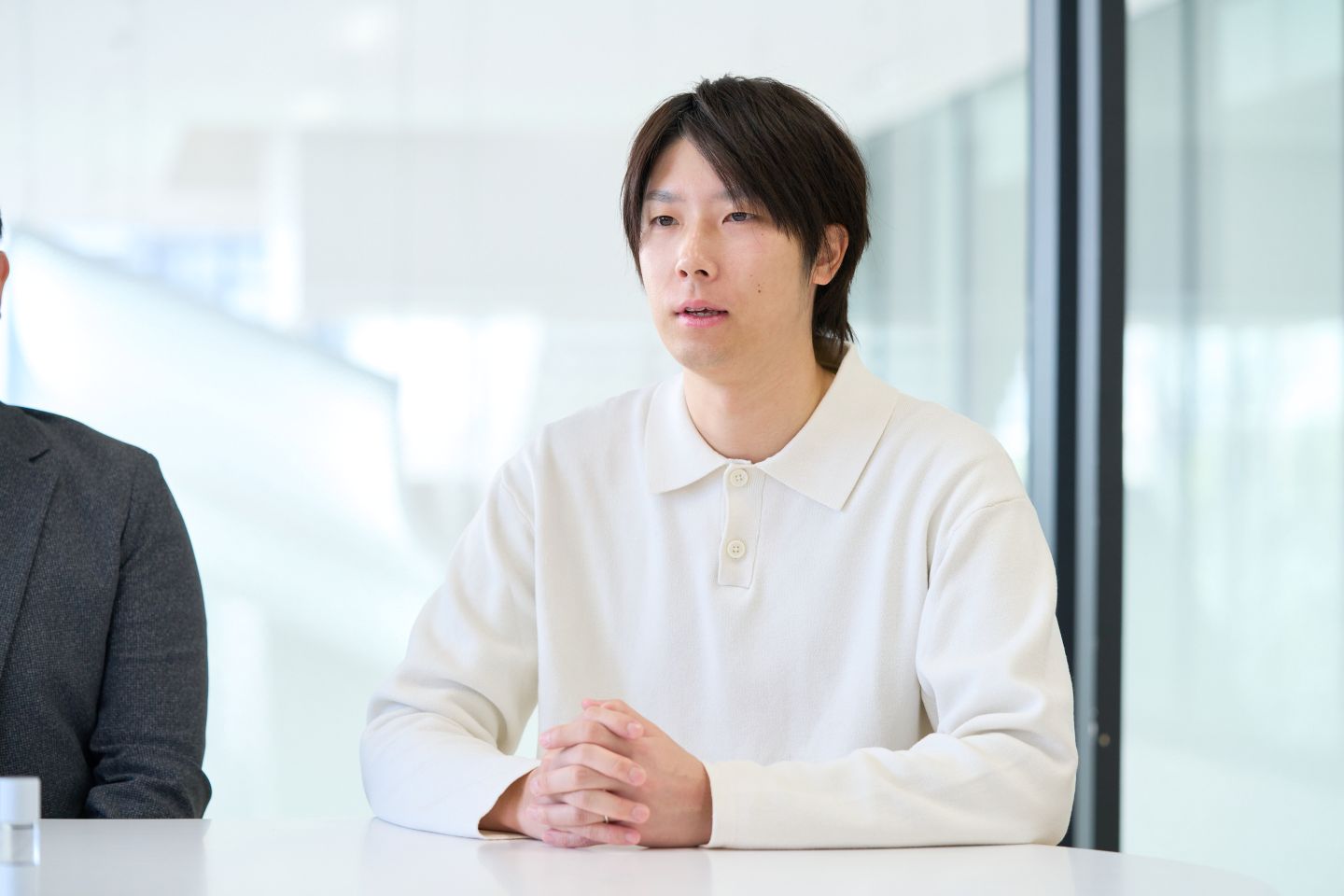
Otaka:
I was in charge of the packaging. I evaluated which container would best suit the characteristics of the formula and determined the optimal size of the dispensing nozzle, conducting various technical assessments along the way.
To bring the designer’s vision of truly embodying “minimalism” to life, I worked on engineering the packaging components—such as the outer sleeve—for mass production, while collaborating closely with the production team to establish the manufacturing process.
— When developing a product under fibona, what did you consider most important? How did the development of “Fluid Serum #1” come about?
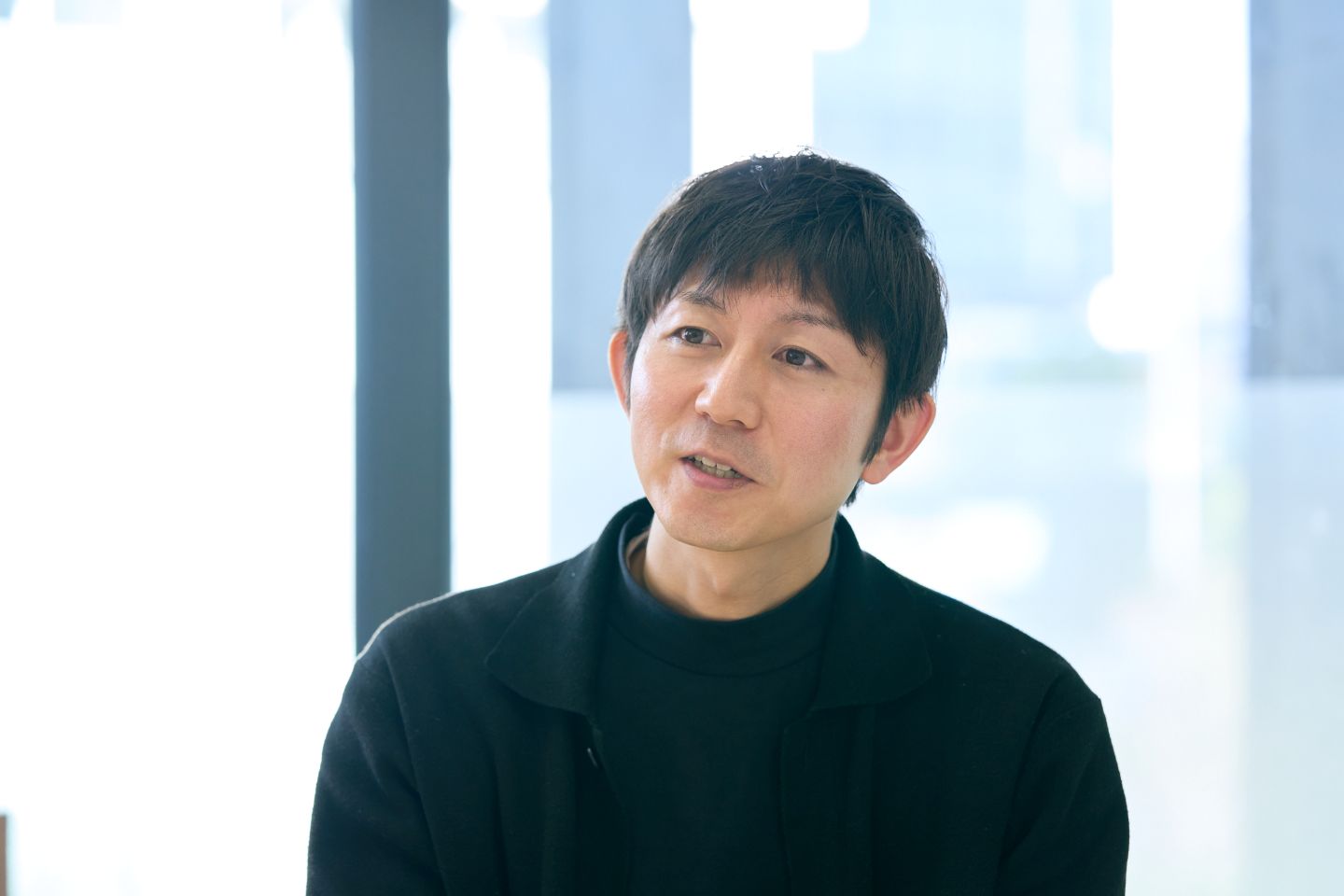
Ueno:
One of our key priorities was how to give form to fibona’s philosophy of “Anti, Ultimate, Transcend.” We had a strong desire to pursue the kind of value that researchers genuinely want to deliver—something that cannot easily be realized within the framework of our existing in-house brands.
What the team focused on was a fundamental approach that only Shiseido researchers could take. Research on glycylglycine at the Shiseido Research Institute received the top award at the IFSCC (International Federation of Societies of Cosmetic Chemists), often referred to as the “Olympics of cosmetic technology.” This ingredient has been shown to address the causes of visible pores and refine skin texture. For many years, Shiseido has been dedicated to studying its effects on pores.
Building on this body of research, we pursued every detail of “Fluid Serum #1”—from its formulation to its packaging—with uncompromising care, aiming to create a sharp, truly minimal product unlike anything we had developed before.
Nishikawa:
Today, consumers are highly knowledgeable about cosmetics. More and more people research ingredients themselves and choose products that suit their individual needs.
At the same time, however, the cosmetics market as a whole sometimes seems caught in a “numbers race,” competing over ingredient concentrations. It becomes a logic of addition—“It’s amazing because it contains X percent.”
I have often questioned whether “higher concentration = greater efficacy” truly holds true. As a researcher, I have always been motivated by the desire to ensure that highly concentrated ingredients are delivered effectively to the skin, without waste.
We wanted to create a product that delivers the highest concentration of glycylglycine to the skin.* To express that sincerity in the product itself, we utilized Shiseido’s proprietary Fluid Crystallization Suppression Technology.
A Proprietary Technology That Delivers High-Concentration Ingredients to the Skin
— So, in order to deliver glycylglycine—an ingredient that helps improve the appearance of pores—to the skin at a high concentration, the Fluid Crystallization Suppression Technology plays a crucial role?
Nishikawa:
The Fluid Crystallization Suppression Technology is a proprietary technology that Shiseido Research Institute has long possessed. One of the key points this time is that we applied it specifically to glycylglycine.
Ueno:
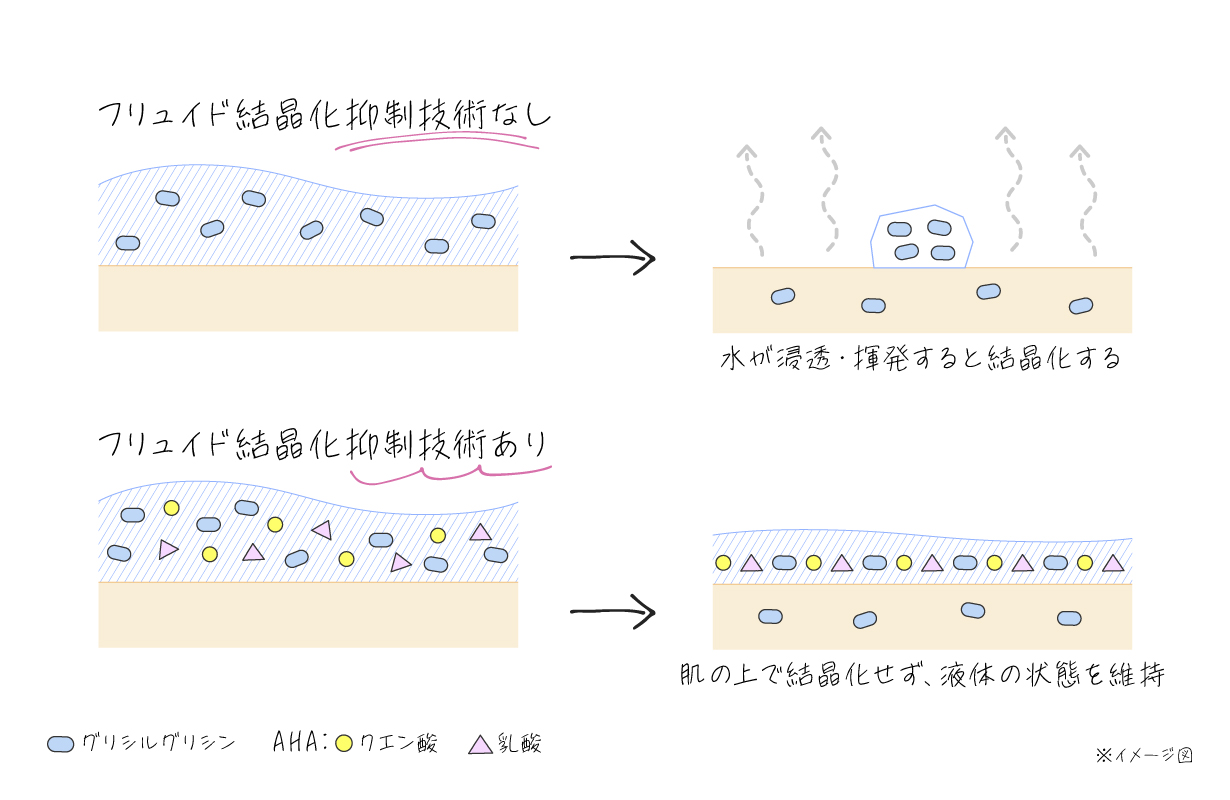
For example, when seawater evaporates, salt crystals remain. No matter how much active ingredient you include in a formula, once it is applied to the skin and the water evaporates, the ingredient can crystallize and harden on the surface, preventing it from penetrating effectively.
Glycylglycine is an ingredient whose efficacy can be enhanced at higher concentrations—but at the same time, the higher the concentration, the more likely it is to crystallize.
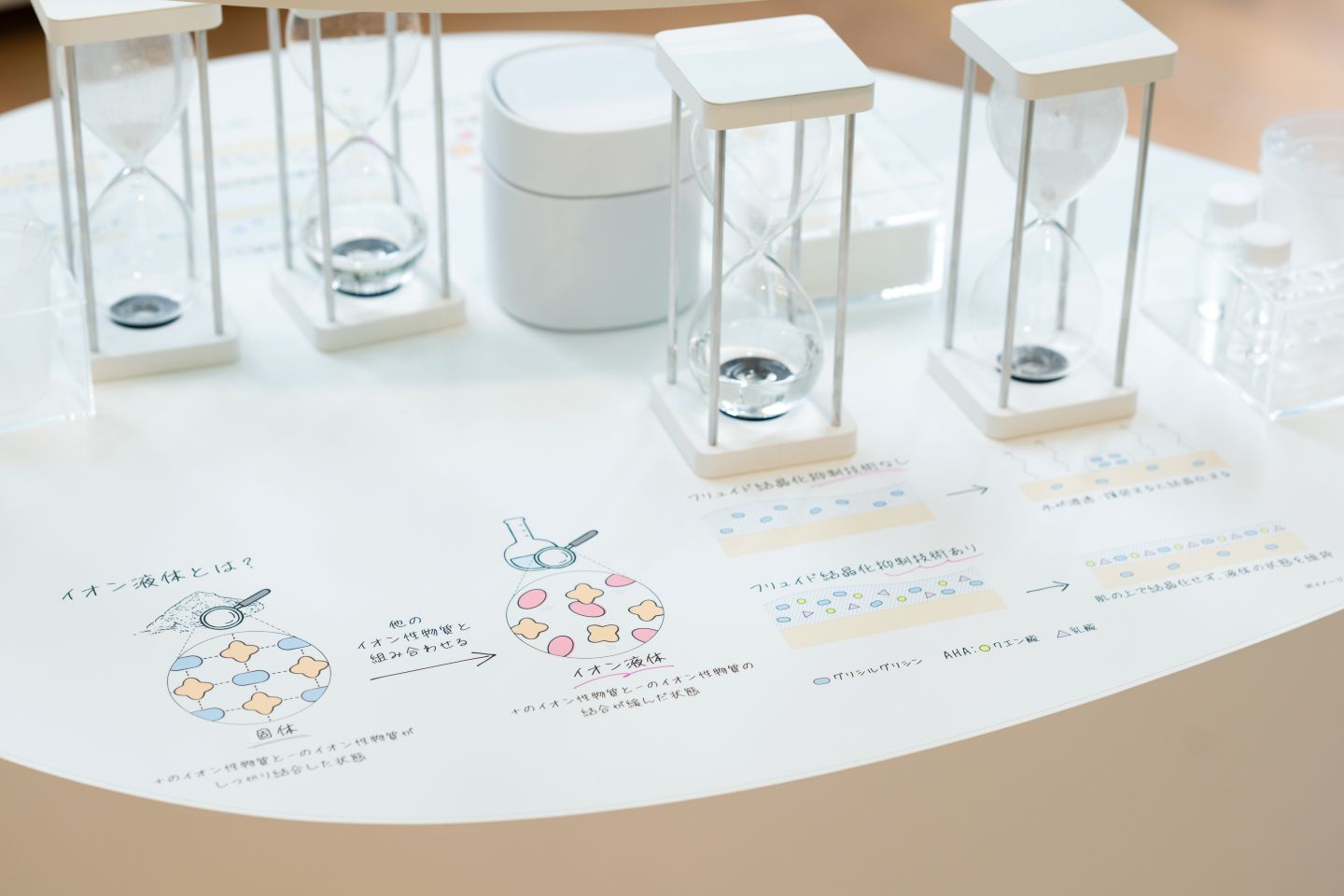
The Fluid Crystallization Suppression Technology enables ingredients to remain in a liquid state even at high concentrations. The concept was inspired by research into ionic liquids*, a field that has been attracting attention in chemistry. Simply put, ingredients that would normally bind tightly together and crystallize are “loosened” by combining them with other components, allowing them to remain fluid on the skin.
Because “Fluid Serum #1” maintains its liquid state through this technology, it can deliver glycylglycine to the skin at an exceptionally high concentration. This technology is what makes the product truly distinctive.
Nishikawa:
Glycylglycine is an ingredient that naturally tends to crystallize. In order to formulate it at the highest concentration and still deliver it effectively to the skin, preventing crystallization was essential. The technology that made this possible is the Fluid Crystallization Suppression Technology, which converts glycylglycine into an ionic liquid.
This was the first time Shiseido applied this technology to glycylglycine, so we had to start our development process from scratch.
Nakamura:
Developing the base formula was my responsibility. There are tens of thousands of ingredients available on the market, and from among them, I searched for the optimal combination that could gently loosen glycylglycine’s tightly bound structure while maintaining long-term stability.
To achieve a truly minimal formulation, we carefully selected and used only nine ingredients in total.
A “Subtractive” Approach to Product Creation—Different from Conventional Development
— Nine ingredients in a cosmetic product sounds exceptionally minimal.
Ueno:
It’s extremely minimal. In our usual product development, the mainstream approach is “addition”—enriching formulas with an abundance of beneficial ingredients for the skin. This time, however, we did the opposite. We stripped everything back as much as possible.
For us, that required a great deal of courage. If you take too much away, you risk ending up with something that feels underwhelming. Even so, we were determined to achieve a form of simplicity that is both effective and refined—a true expression of minimalism.
Otaka:
It’s not simply a matter of adding more “good” ingredients.
Nakamura:
In fact, the simpler the formula, the more challenging it becomes to fine-tune the texture. However, by carefully balancing the proportions within the constraint of just nine selected ingredients, we were able to create a texture that delivers both freshness and lasting hydration in a way that feels truly pleasant on the skin.

— Could you tell us about the texture of “Fluid Serum #1” and how best to use it?
Nakamura:
At first glance, it appears to be a light, fluid liquid with a watery consistency. However, once applied to the skin, it spreads with a burst of freshness and then leaves behind a sensation of moisture that seems to gently cling to the skin.
Hydration is fundamental in skincare, so while we focused on highlighting a single key ingredient, we never compromised on the overall sensorial experience.
Ueno:
The best time to use it is immediately after cleansing. You can complete your skincare routine with this serum alone. However, if you feel you need additional moisture, you can layer your usual lotion or emulsion afterward.
By using it consistently, morning and evening, you should begin to notice improvements in the appearance of pores.
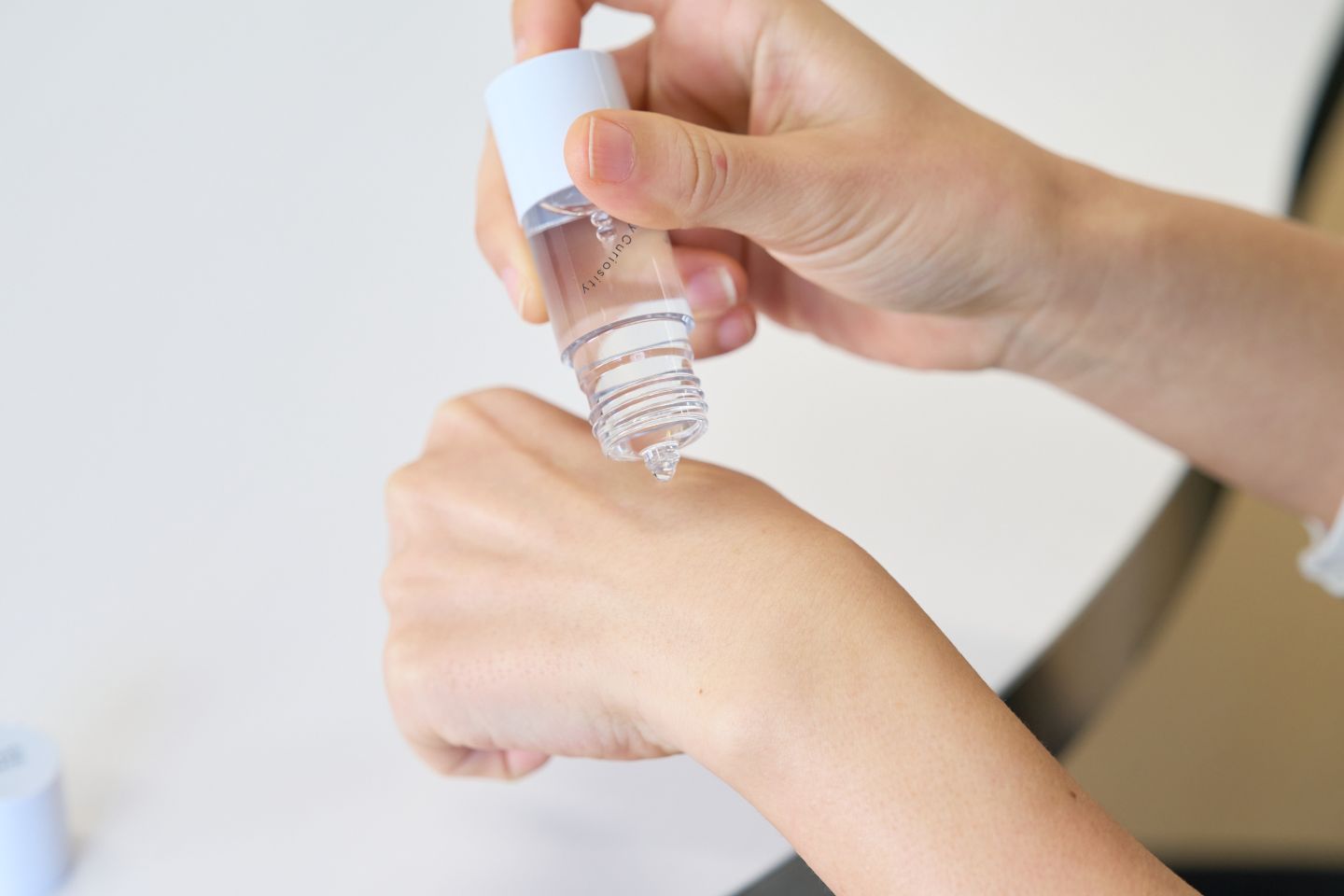
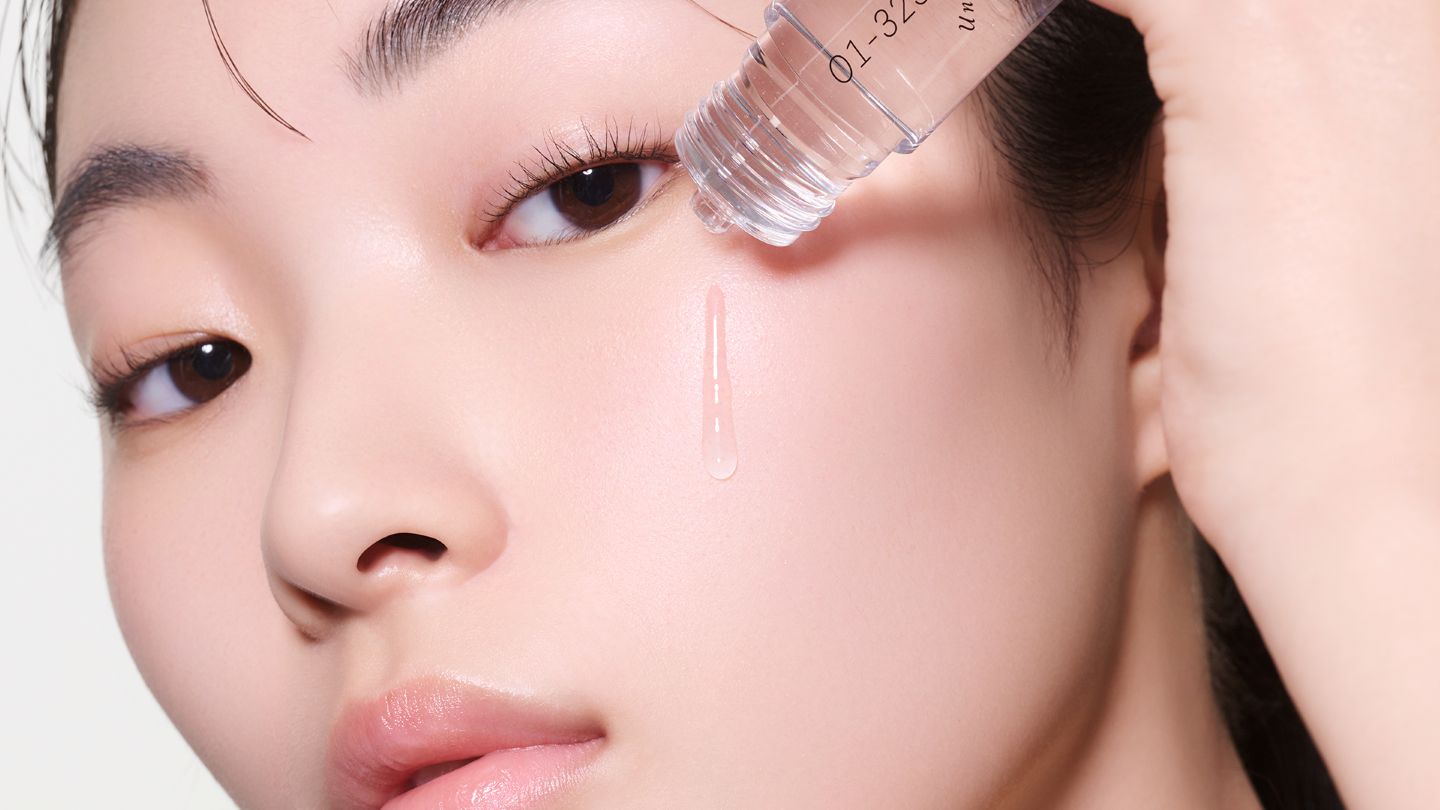
The container is designed with a dropper, allowing you to dispense an appropriate amount directly onto areas of concern. Of course, you can also dispense it into your hands—like a lotion—and gently spread it over your entire face with both palms.
Even the Outer Box Is Stripped Away — The Aesthetics of Minimalism
— “Fluid Serum #1” comes in a dropper-style container, and its minimalist packaging clearly sets it apart from conventional cosmetics.
Otaka:
I am usually responsible for packaging design for Shiseido products. My role is to translate the concept of the formula into physical form and design how it ultimately reaches the customer’s hands.
For this product, we wanted the packaging to fully embody the philosophy of “subtraction rather than addition” and “delivering the maximum with the minimum.” As a result, we arrived at a dropper-style container that delivers the formula directly—and packaging without an outer box.
— It looks quite different from a typical dropper container, both in shape and usability.
Otaka:
Generally, a dropper has a pipette attached to the cap—you squeeze it, draw the liquid up from the bottle, and then dispense it into your hand. But this time, we were determined not to create something that felt interchangeable with other products.
The essence of a dropper is to transport liquid to a specific point. With this container, you simply push the back to release a single drop directly onto the area of concern. It allows you to precisely target where you want to apply it.
By eliminating unnecessary steps, the ingredient travels the shortest possible distance to its target—the pores. I believe the form embodies a kind of functional beauty that reflects this purpose.
— The outer packaging also strongly reflects this idea of “subtraction.”
Otaka:
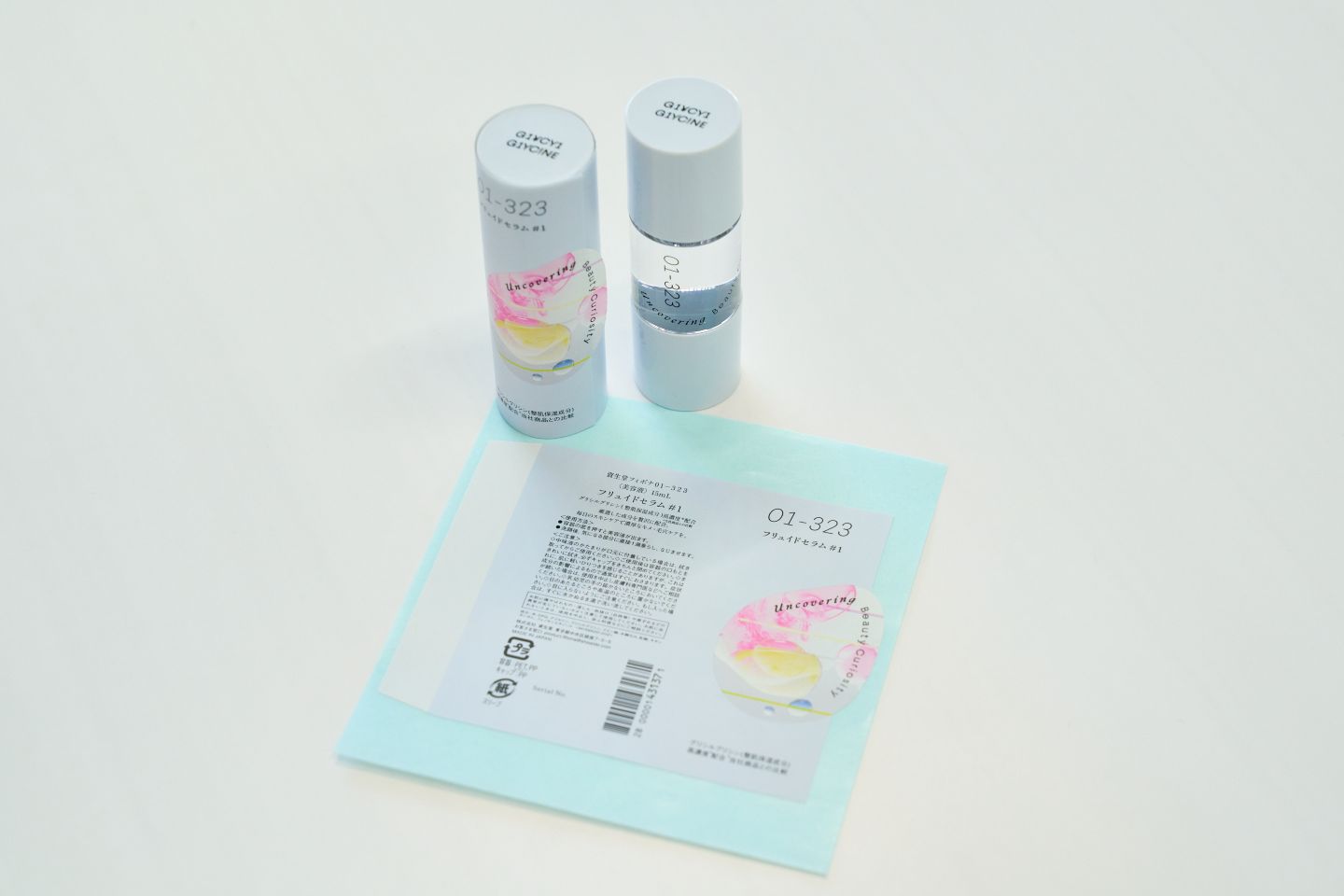
This was the result of thoroughly exploring, as a team, what truly minimal packaging could be. When you place a cylindrical container inside a square box, empty space inevitably appears in the corners. We began to question even that space—it felt unnecessary, wasteful.
That’s when a designer proposed eliminating the conventional paper box altogether, which is standard in cosmetics packaging, and instead wrapping paper directly around the container in a sleeve format. Up until just before the final approval meeting, we kept revising the design—it was quite a challenge (laughs).
In general, placing a product in a box is more efficient in terms of production and offers greater stability. With a paper wrap specification, if the paper is too thin, it lacks durability; if it’s too thick, the tension can cause the adhesive to peel away. We pursued the perfect balance—minimal thickness while ensuring it fits snugly around the container and allows customers to unwrap it comfortably, almost like opening a scroll.
We chose paper over materials such as plastic from a sustainability perspective.
The paper wrapping is done by hand at SBP’s GIC factory. It is labor-intensive, but we believe this process also expresses the craftsmanship that is uniquely fibona.
Ueno:
Even among our own products, I don’t think there’s anything else packaged by wrapping paper directly around the container like this.
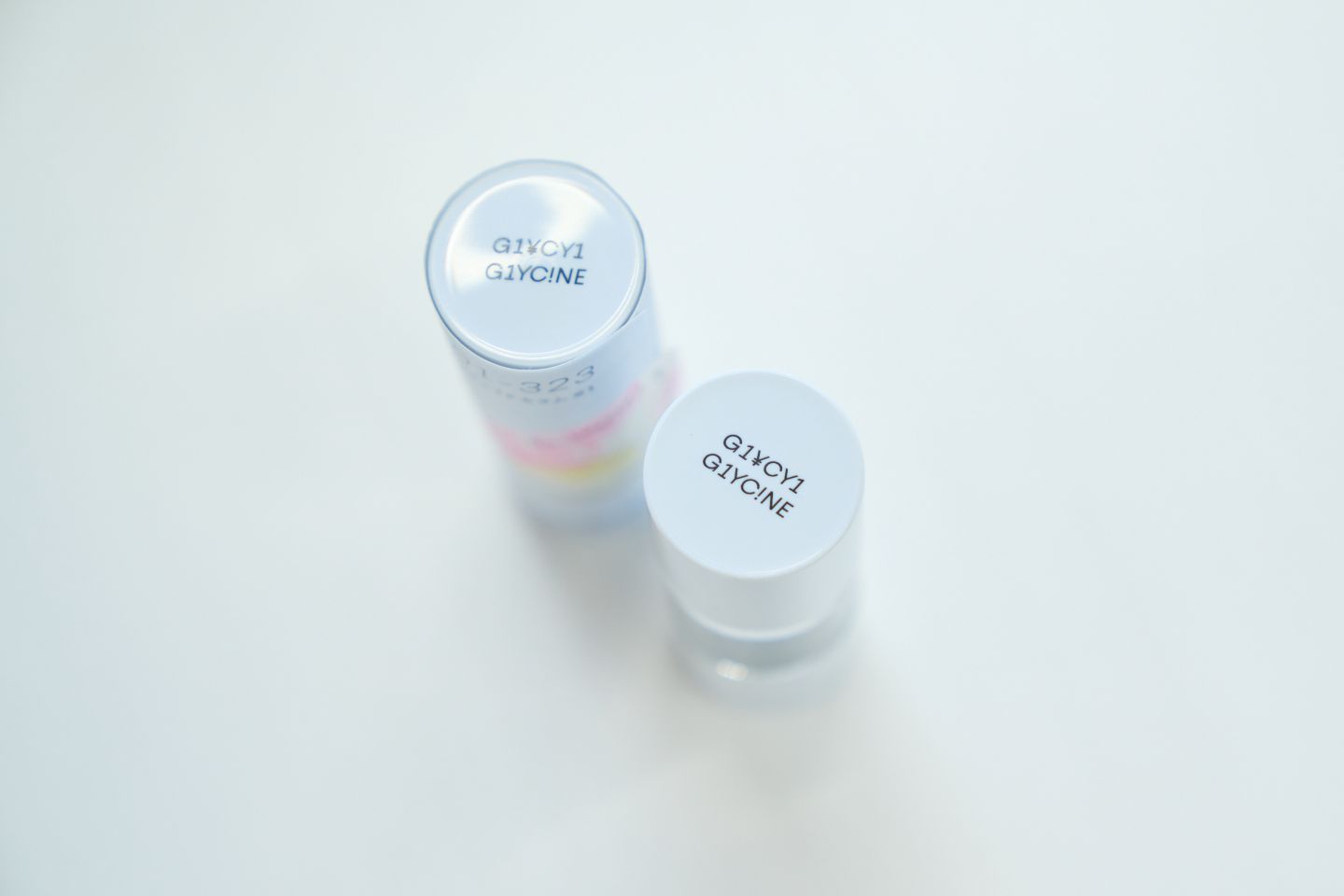
— We’re also curious about the number “323” printed on the container and the mysterious characters at the top.
Nakamura:
The “2” in the middle of “323” actually comes from the structure of glycylglycine, which is a dipeptide. “Di” means “two,” so we chose a number that is connected to the ingredient itself.
Ueno:
As for the text at the top, it’s intentionally designed to look like a kind of “garbled” rendering of the word glycylglycine. Ingredient names can feel technical and unfamiliar to most people. But for us as researchers, they are extremely important.
We decided to play with that contrast—turning the gap between scientific seriousness and everyday perception into something iconic and slightly unexpected through the design.
Experiencing Crystal Growth — Engaging the Five Senses at “fibona Lab”
— Could you tell us about the design of “fibona Lab” on the first floor of SBP, where “Fluid Serum #1” will be launched?
Nishikawa:
No matter how remarkable glycylglycine or our Fluid Crystallization Suppression Technology may be, they are still unfamiliar concepts to most people.
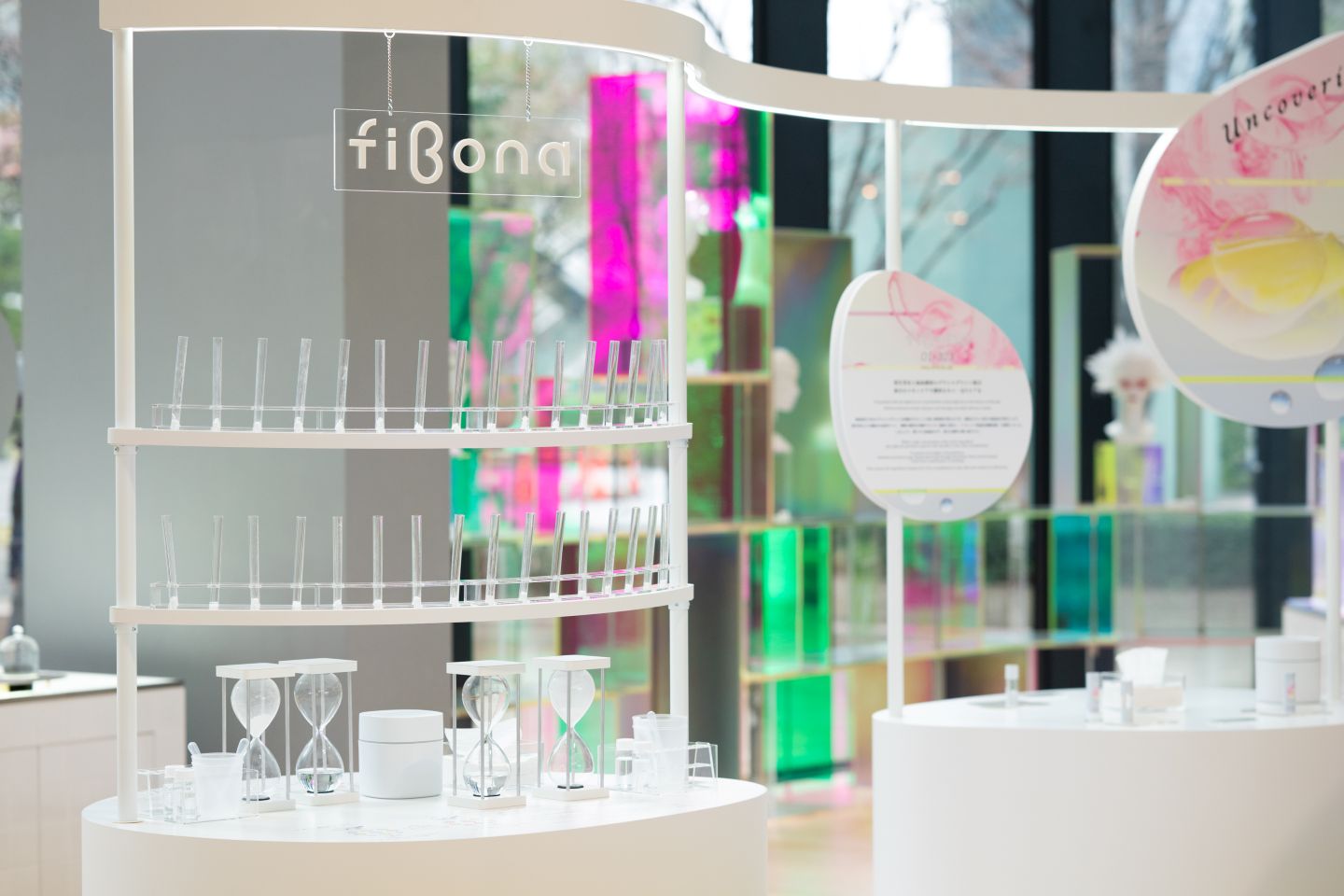
So we wanted to present them in a way that feels engaging and accessible—almost like entertainment. At fibona Lab, we created an interactive booth where visitors can intuitively understand what glycylglycine is and how it works.
— What kind of “experience” can visitors enjoy there?
Nishikawa:
Because glycylglycine crystallizes very easily, we wanted visitors to actually see the moment when crystallization occurs.
In the booth, rows of test tubes are displayed, and visitors are invited to drop an aqueous solution containing dissolved glycylglycine into a test tube themselves. Immediately after being dispensed, it appears to be just a liquid. However, as time passes and it dries, beautiful, snow-like crystals begin to grow and bloom over the course of a few days.
Test tubes prepared by previous visitors several days earlier are also displayed, so you can observe how what you placed today will transform over time. It allows you to witness the process of crystallization as a visible passage of time.
In addition, we have created visual demonstrations that make the Fluid Crystallization Suppression Technology easy to understand. Rather than simply testing the product, we designed the booth so that visitors can take home an “experience”—an appreciation of the materials, the technology, and the story behind them.

From fibona — “Something Truly Exceptional,” Delivered by Researchers
— Who would you most like to see pick up “Fluid Serum #1”?
Otaka:
There may be a general impression that Shiseido’s research labs create products that are “somehow good.” But only through fibona can we deliver something this sharp and uncompromising—something researchers genuinely believe is truly good. We hope people who are sincerely struggling with concerns about pores and their skin will give it a try.
Nakamura:
Our team members use it themselves, and its fresh, easy-to-use texture makes it suitable for a wide range of people. We would love for as many people as possible to experience it. If this product becomes a gateway for people to recognize that “Shiseido has such remarkable technology,” and sparks interest in our other innovations as well, that would be wonderful.
Nishikawa:
Concerns about pores are universal, but they are especially prominent among people in their 20s and 30s, consistently ranking among their top skincare worries. We hope this product reaches not only those with pressing concerns, but also individuals who are highly attuned to beauty and new technologies—as a new option for pore care.
Ueno:
As researchers, we constantly remind ourselves that we are part of the “technology-driven Shiseido Research Institute.” Through this single bottle, we hope people can truly feel that strength. There are countless cosmetics available today, and the abundance of information can make it difficult to know what to choose. In those moments, we aspire to be a trusted presence—Shiseido, powered by technology.
(text: Ikumi Tsubone photo: Umihiko Eto, Yuko Kawashima edit: Kaori Sasagawa)